Use Cases & Resources
Short Interview
We used WELLBAG for spheroid formation of fibroblasts and iNCMSCs*. Even under chondrogenic induction conditions, it enabled the formation of uniform, high-quality spheroids and was very easy to use. Another advantage was that cell suspensions could be introduced using a syringe, which greatly helped reduce the risk of contamination. In addition, spheroid retrieval was quick and simple, which was especially advantageous for projects like ours that require handling large numbers of spheroids at once.
*iNCMSC: iPSC-derived neural crest-derived mesenchymal stem cells
We are using WELLBAG for large-scale liver organoid culture. Its simple operation and closed-system design, which helps reduce the risk of contamination, are major advantages. It is also well suited for simultaneous handling of multiple samples because it enables culture in a compact space. Another attractive feature is that the process from cell seeding to organoid collection is straightforward, allowing stable production of uniform organoids. In addition, the ability to observe the cultures under a microscope during the process makes quality control easier. I would highly recommend this system to researchers involved in organoid research and regenerative medicine.
Long Interview
“From Research to Clinical Use: Advancing iPSC-Derived Islet Cell Manufacturing”
WELLBAG Helps Support Reproducibility and Safety
Orizuru Therapeutics, Inc.
iPSC-derived Pancreatic Islet Cell (iPIC) Therapy Business Unit
Scientist, Process Development, CMC
Ayako Makita
As iPS cell-based regenerative medicine moves closer to practical application, one of the major challenges is how to translate research findings into a robust manufacturing process and deliver them to patients.
In this interview, we spoke with Ayako Makita, Scientist, Process Development, CMC, iPSC-derived Pancreatic Islet Cell (iPIC) Therapy Business Unit, Orizuru Therapeutics, Inc., who is involved in the manufacturing of iPSC-derived islet cells for the treatment of type 1 diabetes. She shared insights into the company’s business, the challenges faced on site, and the effects achieved through the introduction of the WELLBAG-L350.
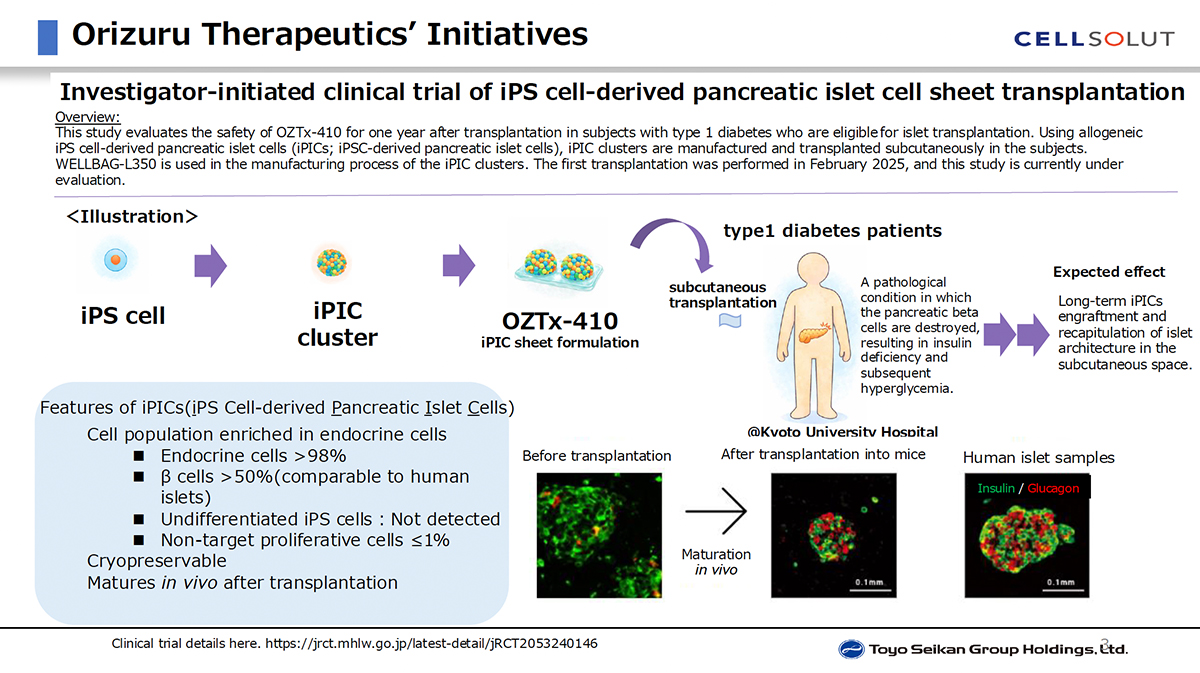
Our company is developing a therapy using islet cells differentiated from iPS cells, aiming to help patients with type 1 diabetes, especially those with severe disease, achieve insulin independence. We are advancing development based on the concept of “treating through cell transplantation,” with the ultimate goal of achieving a cure. (See Fig.1)
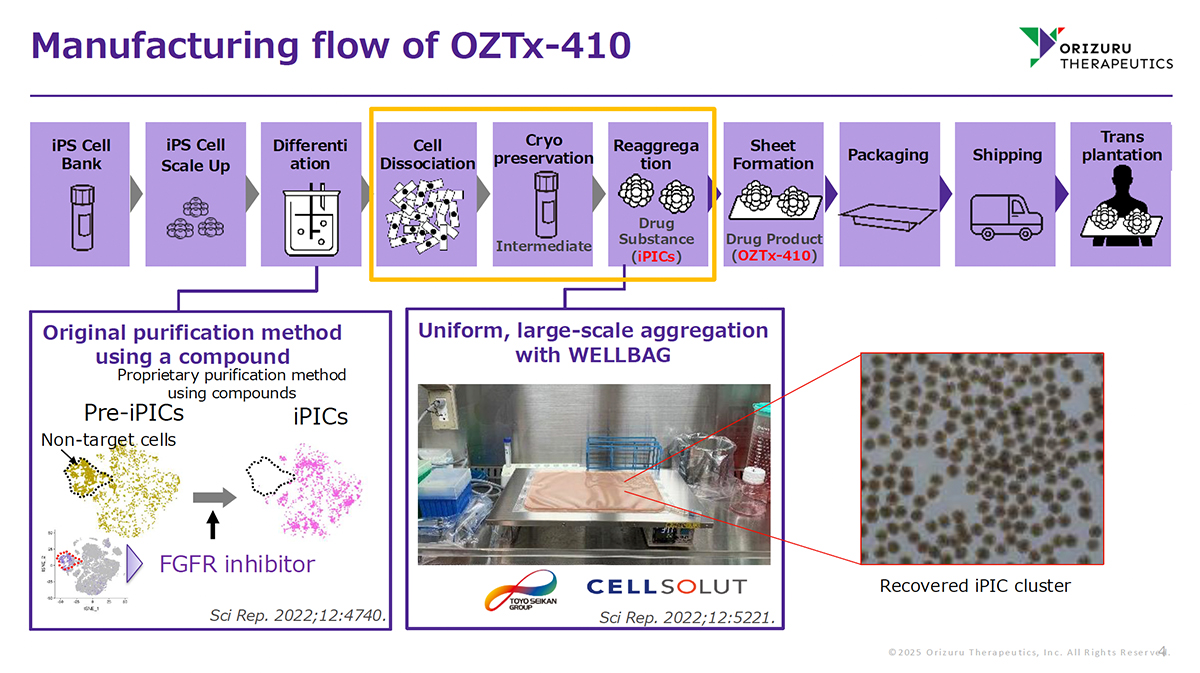
I work in the manufacturing department and am responsible for preparing iPS cell-derived cells into a form that can be delivered to patients. Specifically, I am responsible for the process of dispersing the differentiated cells into single cells, cryopreserving them, and then thawing, washing, and reaggregating them when they are administered to patients. (See the orange section of Fig.2)
The most challenging aspect is that a method established at the laboratory scale cannot always be transferred directly to the manufacturing process. In a manufacturing setting, it is essential to minimize operator-to-operator variability and establish a process that can consistently deliver the same quality and results, regardless of who performs it.
To achieve that, we need to define one step at a time, such as:
- how long the process should take
- under what temperature conditions it should be performed
- how to minimize operator-to-operator variation
The major challenge was to establish a process that does not rely on individual skill. Thinking through how to make it work was enjoyable, but it was also demanding.
The greatest improvement has been in enhancing process reproducibility and reducing the risk of contamination.
In conventional methods, many steps relied heavily on manual work, and differences between operators could affect product quality. In addition, as the process was scaled up, the workload and the burden of aseptic operations increased, making it increasingly important to maintain stable quality while preventing contamination.
By using the WELLBAG, we were able to achieve the following benefits:
- lower contamination risk
- simpler operations
- consistent handling regardless of the operator
- shorter processing time
- easier adaptation to large-scale processing
In particular, the cell seeding step is extremely simple—almost to the point where you can just add the cells and be done—which is a major advantage. In manufacturing, the complexity of a procedure directly leads to risk and variability, so highly reproducible tools are extremely important. For quality testing, our quality control staff also cultured the cells, and they were able to culture the cells in exactly the same way.
It also helped shorten the processing time.
Previously, we had to repeat manual operations many times in order to obtain the required number of cells, but using the WELLBAG made the process much easier. The recovery step is also straightforward and minimizes waste, which has been very helpful. In particular, the recovery method left a strong impression on me, and I truly feel it is a breakthrough innovation.
Another impressive point is that the resulting cell aggregates are very uniform and well formed.
It is not just about appearance; the fact that the process is highly reproducible as a manufacturing step gives us real confidence.
Speaking from a manufacturing perspective, I believe our strength lies in the fact that, while we have a background in basic research, we develop our processes with a strong emphasis on manufacturing.
Because we are handling living cells, it is difficult to maintain stable quality every time, which is one of the major differences from conventional pharmaceutical manufacturing. Taking that into account, I think a major strength is that we design our processes with the end goal of delivering them to patients in mind.
In regenerative medicine, it is not uncommon for things to work at the research stage but then stop at the stage of mass production or stable supply. That is precisely why it is important that products can be made in the same way by anyone, can be manufactured stably, and can be produced at lower cost.
I feel that tools such as the WELLBAG may be a major step toward that goal.
For regenerative medicine to become more widely available in society, I believe the following are indispensable:
- stable manufacturability
- consistent results regardless of the operator
- reduced cost
- minimized lot-to-lot variation
It is not enough to simply say, “we made it” at the research stage. To achieve real social implementation, we need to establish a process that can be reproduced in the same way tomorrow and the same way day after day.
Ultimately, we hope to reduce the daily burden on patients with type 1 diabetes, even if only a little, and deliver this therapy to as many patients as possible.
Editor’s Note
From Ms. Makita’s comments, we strongly felt the importance of translating research outcomes into a process suitable for manufacturing in the practical application of regenerative medicine. The WELLBAG-L350 plays an important role in supporting that process, especially in terms of reproducibility, operability, and safety.
This interview was conducted in May 2026.
Literature
- Ryo S and et al. “Microwell bag culture for large-scale production of homogeneous islet-like clusters.” Sci. Rep. 2022 12 5221
- Kensuke S et al. “CDK8/19 inhibition plays an important role in pancreatic β‑cell induction from human iPSCs.” Stem Cell Research & Therapy 2023 14 1
- Midori Y et al. “Xenogenic Engraftment of Human-Induced Pluripotent Stem Cell–Derived Pancreatic Islet Cells in an Immunosuppressive Diabetic Göttingen Mini-Pig Model.” Cell Trans 2024 33 1-17