

Message from the Chief Financial Officer

Responsibilities and challenges of a Chief Financial Officer
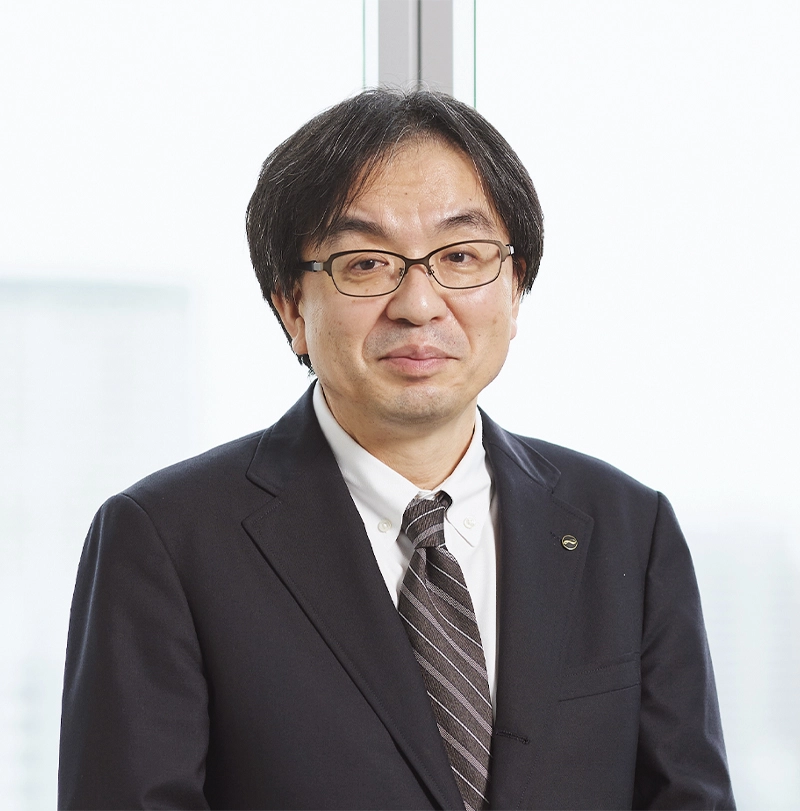
Starting in FY2025, I began serving as Chief Financial Officer. I also continue to serve as Head of Corporate Strategy, and even though it feels like I am carrying a heavier set of responsibilities, I am treating this as a positive challenge.
The primary management issue facing the Group is the execution of Mid-Term Management Plan 2025, which concludes in FY2025, and the implementation of Capital Efficiency Initiative 2027. Another major responsibility is to develop the next mid-term management plan.
Optimizing the business portfolio̶one of the growth strategies in Capital Efficiency Initiative 2027̶requires particular attention. Two years after the initiative began, we have made some progress in improving asset efficiency. However, optimizing the portfolio was deprioritized while we focused on promptly and securely passing through higher raw material and energy costs in the domestic packaging business and other operations.
As plants and production facilities in the domestic packaging business begin aging, I would like to urgently start planning their modernization. Although the Group’s cash flows revolve primarily around the packaging business, as they have in the past, the domestic market is contracting due to a falling birthrate and aging society. This also makes a shrinking workforce inevitable. We therefore must raise production efficiency, not just by simply replacing facilities, but also through the application of DX and IoT. My intent is to formulate a progressive set of renewal plans that encompass the merging of multiple production lines.
FY2024 business performance
Domestic business solid with progress in cost pass-throughs, and overseas weak, particularly in North America. This kept operating income growth to a mere 1.0%.
For our business performance in FY2024, net sales were 922.5 billion yen (down 3.0% year on year), while operating income was 34.2 billion yen (up 1.0% year on year), meaning that profits rose while sales fell. Ordinary income was 37.5 billion yen (down 3.0% year on year) and profit attributable to owners of parent was 22.3 billion yen (also down 3.0% year on year).
In the domestic business, revenues increased by 24.6 billion yen due to the continued pass-throughs of rising raw material costs in the packaging business, boosted by an additional 6.6 billion yen increase due to the recovering market in the functional materials related business, for a 31.3 billion yen increase overall. In the overseas business on the other hand, revenues fell by 59.4 billion yen due to the adverse effects of worsening market conditions in the North American engineering business. The combined result was reduced consolidated net sales.
In operating income, positive growth in the domestic business made up for lower profits in the overseas business, for a slight increase of 1.0% year on year. In the domestic engineering business, we had to write off bad debts due to customer business failures. Nevertheless, the domestic business grew profits by controlling costs through measures to cope with rising raw material prices and a reduction in retirement benefit obligations. Overseas, however, profits fell due to the significant impact from decreased revenues in the North American engineering business.
Capital Efficiency Initiative 2027, growth strategy
Healthy expansion in demand for components and materials for automotive rechargeable batteries. For solar cells, new products being released.
Capital Efficiency Initiative 2027 sits atop two supports̶the growth strategy and the capital and financial strategy. In the growth strategy, with the goal of optimizing our business portfolio, our plans in the domestic packaging business call for rectifying prices and restructuring and rebuilding unprofitable operations. In other businesses, including the engineering, filling, and logistics businesses; the steel plate related business; and the functional materials related business, we intend to expand our domain of operations.
Thanks to steady progress in passing on cost increases in the domestic packaging business, fewer business segments are now loss-making, allowing us to substantially narrow the list of businesses targeted for restructuring and rebuilding. For the Toyo Seikan Group, the packaging business is critical for generating stable cash, yet in FY2023 and FY2024 we had to take impairment losses on certain businesses. In response, we are continually examining rebuilding measures.
On the other hand, in the growth areas where we expect the Group’s future expansion and have been actively investing management resources, progress has been made. In FY2023, we made large investments totaling 15.5 billion yen in new facilities and added capacity for the manufacturing of components and materials for automotive rechargeable batteries, where demand continues to expand. In August 2024, we acquired the Malaysian company PREMIER CENTRE GROUP SDN. BHD. (PCG), which runs a filling business for home care and personal care products.
As a result, these investments have made a certain contribution to FY2024 Group earnings. In business domains where growth is promising, we would like to establish a more solid foothold for Group growth by continuing to concentrate committing our management resources there, including money and people.
I would now like to look at the FY2025 outlook by business. In the domestic packaging business, we project that the cost pass-throughs carried out through all of FY2024 in conjunction with the rising prices of raw materials and energy will run to completion during this fiscal year.
In the North American engineering business, performance is trending upward after bottoming out in the fourth quarter of FY2024. On the downside, major European and North American beverage makers̶our existing customers̶are maintaining capital spending controls with no significant changes observed. On the upside, there are increased orders from emerging markets, such as those in the Middle East, India, and South Africa. We are looking to add to this new demand and are working toward a recovery in business performance.
In the filling business, we foresee the continued growth of demand in the Asia region and are considering additional production capacity. The inclusion of PCG’s business performance in consolidated reporting started in the third quarter of FY2024. We note that net sales and profits are in line with original assumptions and look forward to the company making a full-scale contribution in FY2025.
In the steel plate related business, we expect that Toyo Kohan will make a large contribution to profits as there continues to be strong sales of components and materials (nickel-plated steel sheet) for automotive rechargeable batteries. This nickel-plated steel applies technology developed in the manufacturing of materials for metal cans and optimizes rolling and surface treatment, thereby making a sizable increase to value added. Toyo Kohan is highly regarded for its advanced technology developed in the manufacturing of materials for metal cans and is actively applying its know-how to the development of new products, starting with battery components and materials. The rechargeable battery sector is known for the high speed of its technological innovation, with the two main types of new batteries, nickel hydrogen and lithium ion, approaching practical application as next-generation products.
We are also seeing a rise of new production facilities in line with advances in technology, which is becoming more critical along with investment in R&D.
Capital Efficiency Initiative 2027, capital and financial strategy
In share repurchasing, expecting to complete 80 billion yen worth over FY2023–2025. For ROE, a steady advance on a target of 8.0% or more.
One of the key pillars of Capital Efficiency Initiative 2027 is the capital and financial strategy, which includes optimizing the capital structure―such as lowering the equity ratio―to improve capital efficiency. In FY2022, we set a target of lowering equity capital from 643 billion yen to 600 billion yen by FY2027. To this end, we have steadily acquired 20 billion yen of our own shares in FY2023 and 30 billion yen in FY2024. In addition, amid continued growth in net assets driven by the cheaper yen and higher share prices, I will convey to our shareholders and investors the Group’s stance of taking steady actions to achieve our plan with a sense of urgency. To this end, in 2025 we have pushed forward share repurchasing from May to March. For us, the repurchase of a total of 100 billion yen in shares, as planned for FY2027, would constitute achievement of our target.
Regarding dividends, Mid-Term Management Plan 2025 describes three policies through its final year: total return ratio of 80%, a consolidated dividend payout ratio of 50% or higher, and no dividend cut versus the previous fiscal year. These policies remain in place as we continue to focus efforts on shareholder returns.
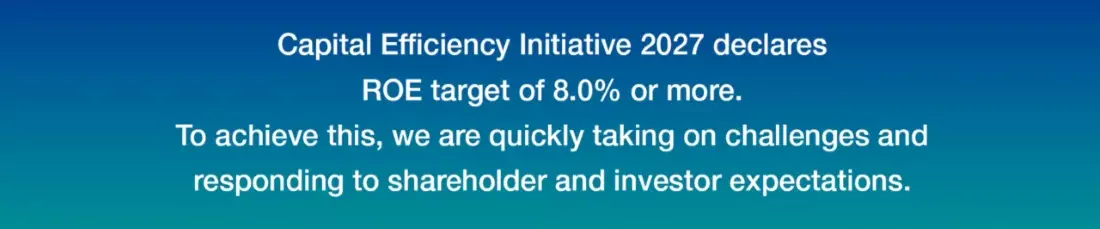
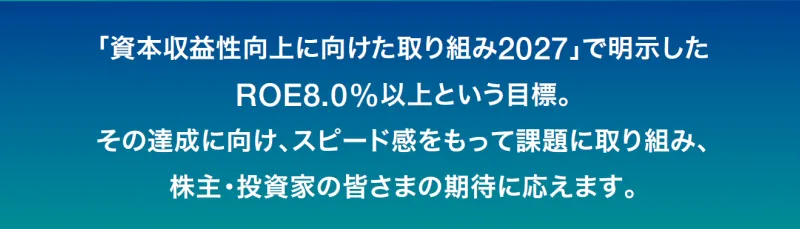
Our ROE target, which is stated in Capital Efficiency Initiative 2027, is to achieve 8.0% or higher by FY2027, which is quite a high hurdle to clear. Our FY2025 outlook*puts ROE at 6.9%, however, or 5.3% after extraordinary income is excluded. Nevertheless, these numbers appear to show steady progress on both fronts for capital efficiency and profitability. We intend to meet our 8.0% ROE target by plowing forward in the coming years on accelerating our growth strategy and restructuring and rebuilding unprofitable operations, which are not invulnerable to such actions.
* Values announced on May 14, 2025
Capital Efficiency Initiative 2027, cash allocation
Selling off strategic shareholdings to secure a cash line. Proactive investment in growth fields puts cash to effective use.
Under Capital Efficiency Initiative 2027, the core of our cash allocation strategy is to optimally allocate operating cash flows and cash from asset disposals as well as fundraising to investments and shareholder returns. From FY2023 to FY2027, we anticipate approximately 80 billion yen in proceeds from asset disposals and fundraising and 370 billion yen in operating cash flow. Of this 450 billion yen total, we plan to allocate 270 billion yen to growth investments and strengthening our business foundation, and 180 billion yen to shareholder returns.
- The image can be scrolled left and right
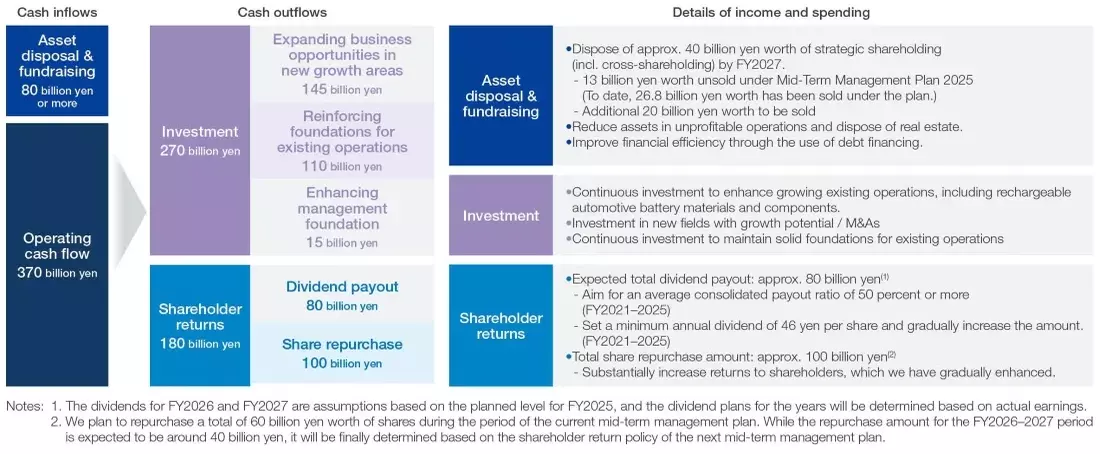
Within the figure for asset sales and fund procurement are sales of strategic shareholdings. They were set at 40 billion yen on the consolidated balance sheets in Mid-Term Management Plan 2025, with an additional 20 billion yen on the same basis in Capital Efficiency Initiative 2027, for total targeted disposition sales on the order of 60 billion yen on a consolidated balance sheet basis. In the four years through to FY2024, we already proceeded to sell 26.8 billion-yen worth of these shareholdings and plan to realize disposal sales of 16.0 billion yen in FY2025. So that we can complete sales of the targeted amount by FY2027, we will continue to engage in this activity.
To our stakeholders
As we move toward achieving Capital Efficiency Initiative 2027, I will focus particularly on improving profitability and capital efficiency. While noting that the targets are ambitious, I will tackle the challenges with a strong sense of urgency. Since announcing this initiative, I have emphasized the importance of focusing on profitability rather than merely on net sales or market share. Over the past two years, I believe this mindset has become widespread across the Group. I will work with all my powers in a vigorous effort to institute a transformation of awareness within the Group and will continue to take on the challenges of meeting our targets.
( 2025.9 )