

Integrated Information Disclosure Based on the Recommendations of the TCFD and TNFD


Based on the management philosophy of "Always creating new value, pursuing the realization of a sustainable society, and contributing to the happiness of humanity," Toyo Seikan Group has formulated the "Toyo Seikan Group Sustainability Charter" and promotes sustainability management across the entire group. Additionally, we have set the medium-term environmental goal "Eco Action Plan 2030" and are implementing various initiatives to reduce environmental impact. Regarding climate change initiatives, we expressed support for the recommendations of the "Task Force on Climate-related Financial Disclosures" (hereinafter "TCFD") in 2021, and for the conservation of natural capital and biodiversity, we began initiatives based on the "Task Force on Nature-related Financial Disclosures" (hereinafter "TNFD") starting in 2024. This page reports Toyo Seikan Group 's efforts on climate change and natural capital and biodiversity in accordance with the TCFD and TNFD's recommended disclosure frameworks.
"Integrated Information Disclosure Based on the TCFD and TNFD Recommendations" PDF versionGovernance
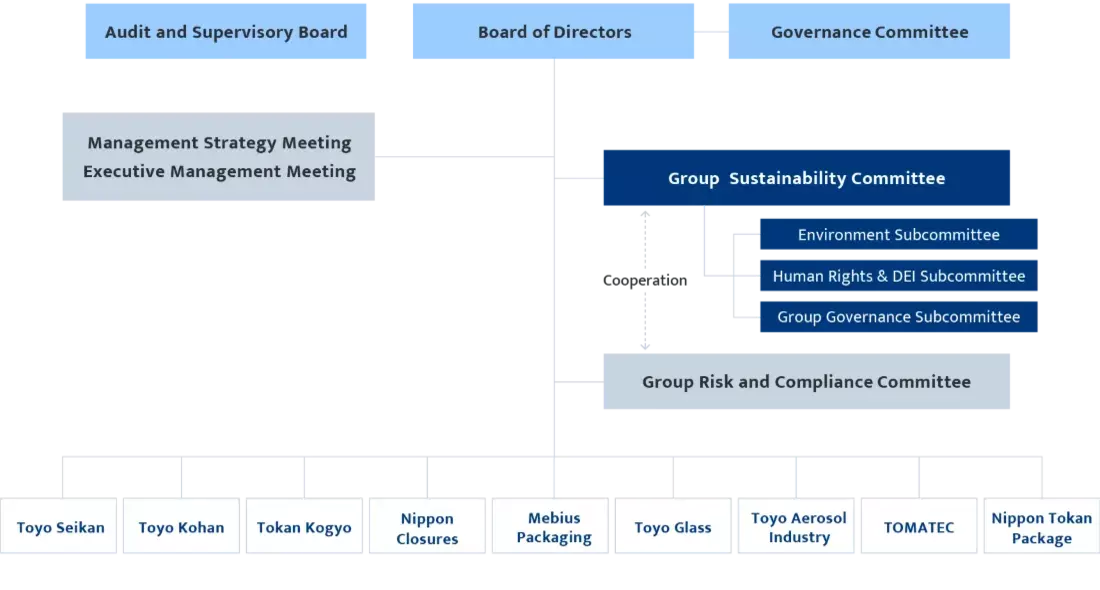
Toyo Seikan Group has established a Group Sustainability Committee to oversee all group-wide sustainability-related activities, including addressing climate change and challenges related to natural capital and biodiversity. This committee, along with the Group Risk and Compliance Committee, is positioned as one of the key committees. This committee serves as a forum for discussions on matters related to promoting sustainability management, and in addition to managing progress on targets and plans, it reviews plans in light of social and international conditions, regulatory trends, and changes in the external environment, and considers new measures. This committee also manages progress management of the "Eco Action Plan 2030," which targets and plans related to climate change and natural capital and biodiversity. Additionally, Toyo Seikan Group recognizes various social issues in countries and regions, engaging in dialogue and collaboration with stakeholders such as customers, business partners, and local communities who use Toyo Seikan Group 's products and services, and works to solve social issues through its business activities.
*The image can be scrolled left and right.
Risk Management
Toyo Seikan Group Regarding overall risk management, the Group Risk and Compliance Committee checks the situation and implements improvements and preventive measures. Additionally, each group company formulates risk management policies and basic plans under its own promotion system, and compiles the company-wide risk management status. Environmental risks, including climate change and natural capital and biodiversity, are also discussed at Group Sustainability Committee and are treated as one of the Toyo Seikan Group 's key risks by the Group Risk and Compliance Committee.
Strategy: Climate Change
Referring to climate change scenarios published by organizations such as the IEA (International Energy Agency), we selected scenarios of 1.5~2°C and 4°C. Recognizing that the impacts of climate change will become apparent in the long term, we analyze the impact of climate change in 2050 as a time horizon.
Analyzed businesses: Packaging Business, Engineering, Filling and Logistics Businesses, Steel Plate Related Business, Functional Material Related Business
Scenario analysis
Transition Risk
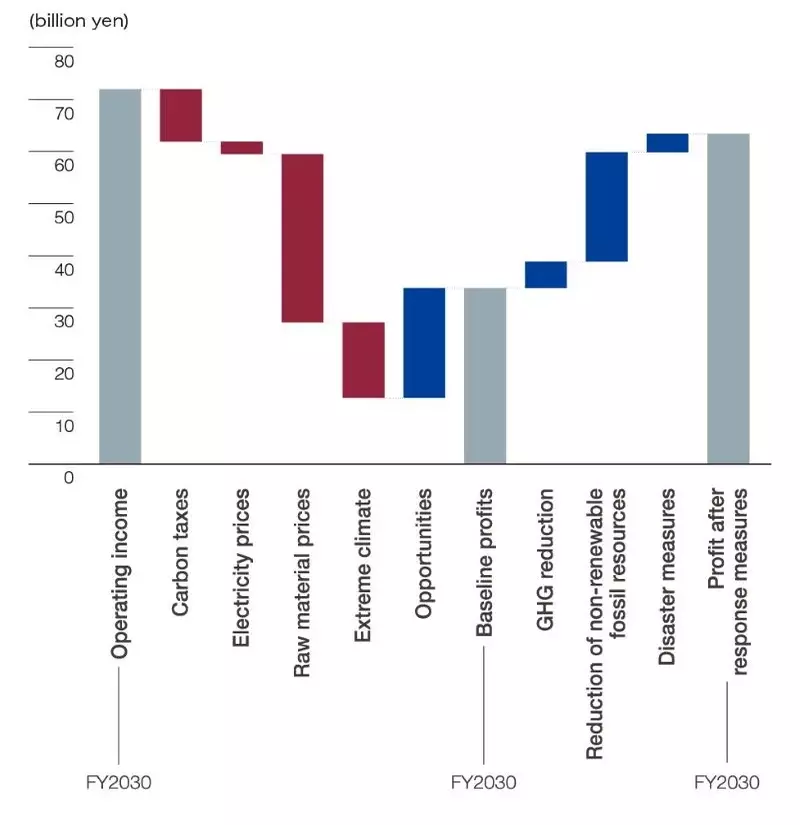
In the 1.5~2°C scenario where climate change policies are introduced, we identified a cost increase risk of about 40 billion yen due to operating costs from carbon tax impositions and procurement costs for petrochemical raw materials and steel materials. As a response, we confirmed that GHG reduction aimed at carbon neutrality by 2050 and further promotion of the 3R for depletion and fossil resources can largely offset negative impacts.
In addition, Toyo Seikan Group is introducing an internal carbon pricing system (ICP) applying shadow prices, anticipating future carbon tax impositions and rising raw material prices. We set the carbon price at 10,000 yen per t-CO2 and utilize it for GHG reduction investments such as energy-saving equipment and renewable energy introduction, working toward achieving a roadmap toward a carbon-neutral society.
Physical Risks
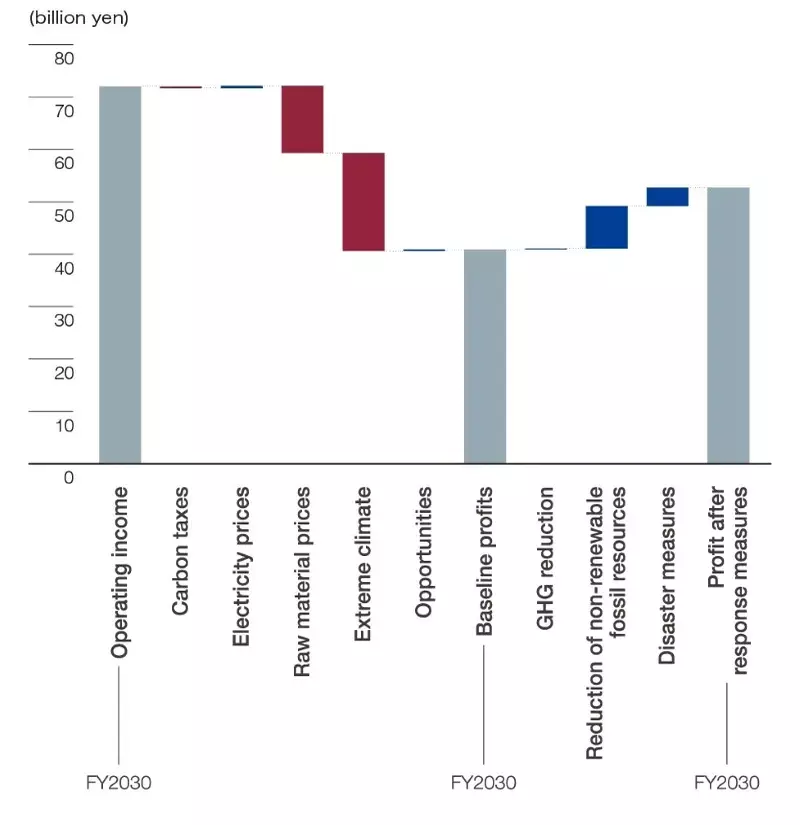
Under the 4°C scenario, climate change has led to increased drought risks in areas with high water stress and increased flood risks due to more severe extreme weather events, potentially resulting in financial impacts exceeding 30 billion yen. We will establish a comprehensive water risk management system (to be operational from 2024) to mitigate these negative impacts.
Opportunity
In the 1.5~2°C scenario, we identified opportunities worth over 30 billion yen related to increased demand for environmentally friendly products and battery components for EVs and PHEVs. We will assess upcoming demand increases and prepare for strengthening production systems, striving to steadily turn these opportunities into Toyo Seikan Group growth.
List of scenario analysis results
Transition Risk
*The table can be scrolled left and right.
| Important risks and opportunities | Timeline | Financial impact on Toyo Seikan Group | Toyo Seikan Group 's response | |
|---|---|---|---|---|
| policy· Regulation |
Carbon tax burden |
short term |
New carbon tax increases operating costs |
|
| Fluctuations in electricity prices |
short term |
Increase in operating costs due to rising electricity prices |
|
|
| Plastic tax imposed on containers and packaging made from virgin plastic |
long term |
Decrease in sales when new taxes are introduced and the tax amount is deducted from the unit price |
|
|
| Mandatory use of recycled plastic in beverage bottles |
short term |
Increased costs due to increased recycled plastic content |
|
|
| Raw material prices | Fluctuations in petrochemical raw material prices due to fluctuations in crude oil prices |
short term |
Fluctuations in petrochemical raw material procurement costs due to fluctuations in crude oil demand |
|
| Fluctuations in raw material prices due to carbon taxes |
short term |
The introduction of a new carbon tax will increase procurement costs for petrochemical raw materials, steel, aluminum, paper, and glass. |
|
|
| The impact of green steel |
long term |
Increase in steel procurement costs due to the spread of green steel |
|
|
Physical Risks
*The table can be scrolled left and right.
| Important risks and opportunities | Timeline | Financial impact on Toyo Seikan Group | Toyo Seikan Group 's response | |
|---|---|---|---|---|
| weather changes | Water intake suspended due to drought |
short term |
Production activities are restricted in areas with high water stress |
|
| Impact of rising temperatures on air conditioning |
short term |
Increased operating costs due to increased air conditioning power consumption in summer |
|
|
| Increasing severity of extreme weather | Property damage and lost profits due to the disaster |
short term |
Increased property damage and lost income due to increased flood risk |
|
Opportunity
*The table can be scrolled left and right.
| Important risks and opportunities | Timeline | Financial impact on Toyo Seikan Group | Toyo Seikan Group 's response | |
|---|---|---|---|---|
| Changes in consumer behavior | Increasing demand for environmentally friendly products |
short term |
Increased sales of environmentally friendly products |
|
| Increasing demand for pesticides |
short term |
Rising average summer temperatures have led to increased demand for insecticides, leading to increased sales in the aerosol filling business |
|
|
| Expanding low-carbon products | The spread of EVs and PHEVs |
long term |
Demand for battery components used in EVs and PHEVs is increasing, leading to increased sales. |
|
[Regarding the time horizon] Short-term: From now until around 2030, Long-term: From around 2030 until around 2050
Impact on operating profit (FY2030 1.5-2°C scenario)
Impact on operating profit (FY2030 4°C scenario)
Water risk assessment
Among the physical risks of climate change, drought risk and flood risk were confirmed to have a significant impact on Toyo Seikan Group 's management. Therefore, we conducted risk assessments targeting 93 major production sites in the group both domestically and internationally, using the water risk assessment tool Aqueduct developed by the World Resources Institute (WRI) and ENCORE developed by the Natural Capital Finance Alliance (NCFA). As a result, the six sites selected as priority sites were the following *.
Toyo Seikan Group focuses on sites with high risk identified in this evaluation to minimize water risks and contributes to solving water issues in each region.
| Water resource risk | 2 overseas bases |
|---|---|
| Regulatory and reputational risks | 1 overseas base |
| Flood risk | 3 domestic locations, 2 overseas locations |
Strategy: Natural capital and biodiversity
As part of our initiatives based on TNFD recommendations, we conducted assessments of all Toyo Seikan Group production sites and business activities regarding dependence and impact on natural capital and biodiversity.
Assessment of environmental risks arising from the location of business sites
Toyo Seikan Group conducted assessments of natural capital and biodiversity risks originating from each location using BRF* across all production sites. As a result, multiple risk factors were identified. Among physical risks, scores for "tropical cyclones (typhoons)" and "pollution" caused by the site location were particularly high, positioning them as risk factors that should be prioritized as Toyo Seikan Group countermeasures.
Regarding the risk of a "tropical cyclone (typhoon)," it can affect sites and the entire value chain in various ways, such as damage to land and buildings due to wind and rain, flooding inundation, and power outages. Therefore, risks such as temporary or long-term closure of production sites and loss of revenue are anticipated. Regarding the risk of "pollution" originating from the location, contaminated land, water, and air may cause product quality declines and employee health hazards.
Toyo Seikan Group will consider and implement risk reduction measures at each site to minimize the impact of these risks.
Map of East and Southeast Asian regions with high risk of tropical cyclones (typhoons) identified by BRF *
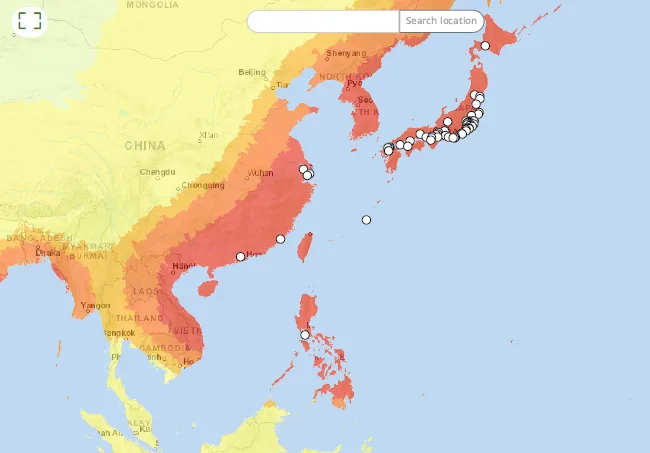
Map of Group bases in East Asia and Southeast Asia with high contamination risk identified by BRF *
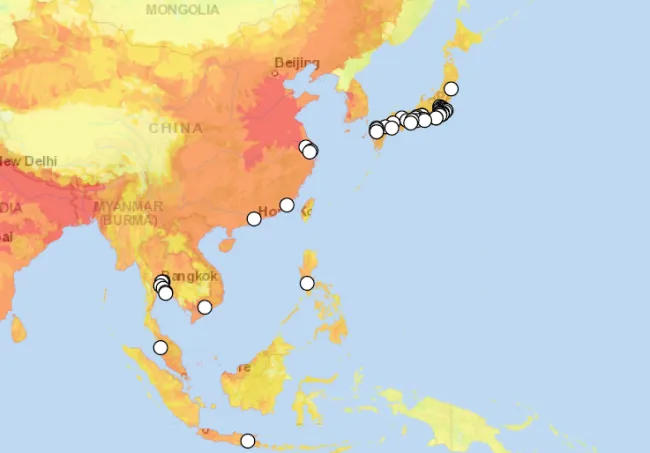
- The Biodiversity Risk Filter (BRF) is an online tool announced by the World Wide Fund for Nature (WWF) at the World Economic Forum (Davos Conference) in January 2023 to screen and prioritize biodiversity-related risks in a company's business or supply chain.
Relationship between business activities and natural capital/biodiversity
We evaluated the impact of Toyo Seikan Group 's business activities on natural capital using ENCORE.
As a result, it was revealed that 'discharge of hazardous pollutants into water and soil' has the greatest impact on the natural environment. Additionally, factors such as 'disturbances (noise, light, etc.)' and 'greenhouse gas emissions' have also been identified as influencing factors in Toyo Seikan Group 's business. To reduce these risks, Toyo Seikan Group systematically implements disaster prevention measures for land and buildings at each site, as well as measures to prevent waste leakage. This helps limit the scope and extent of damage to assets and surrounding environments during natural disasters or accidents, aiming to reduce the time and cost required for recovery. Furthermore, strengthening such proactive risk management is believed to help suppress increases in product liability insurance and liability insurance premiums.
The relationship between ENCORE's Toyo Seikan Group businesses and natural capital and biodiversity
Analyzed businesses: Packaging Business, Engineering, Filling and Logistics Businesses, Steel Plate Related Business, Functional Material Related Business
*The table can be scrolled left and right.
| Natural change factors in TNFD | pressure | The impact of our group's business on natural capital |
|---|---|---|
| Resource utilization/complementation | Water usage | Medium |
| Other biological resource collection (fish, timber, etc.) | N/A | |
| Other biological resource collection | N/A | |
| Changes in land, freshwater, and marine use | Land use area | low |
| Freshwater area | N/A | |
| Seabed area used | N/A | |
| Climate change | greenhouse gas emissions | Medium |
| Emissions of air pollutants other than greenhouse gases | Medium | |
| Solid waste generation and discharge | Discharge of harmful pollutants into water and soil | high |
| Nutrient pollutant discharges to water and soil | low | |
| Solid waste generation and discharge | low | |
| External disturbances (noise, light, etc.) | Medium | |
| Invasive alien species introduction/removal | Invasion of invasive species | N/A |
- N/A: No impact
Indicators and Goals
GHG reductions
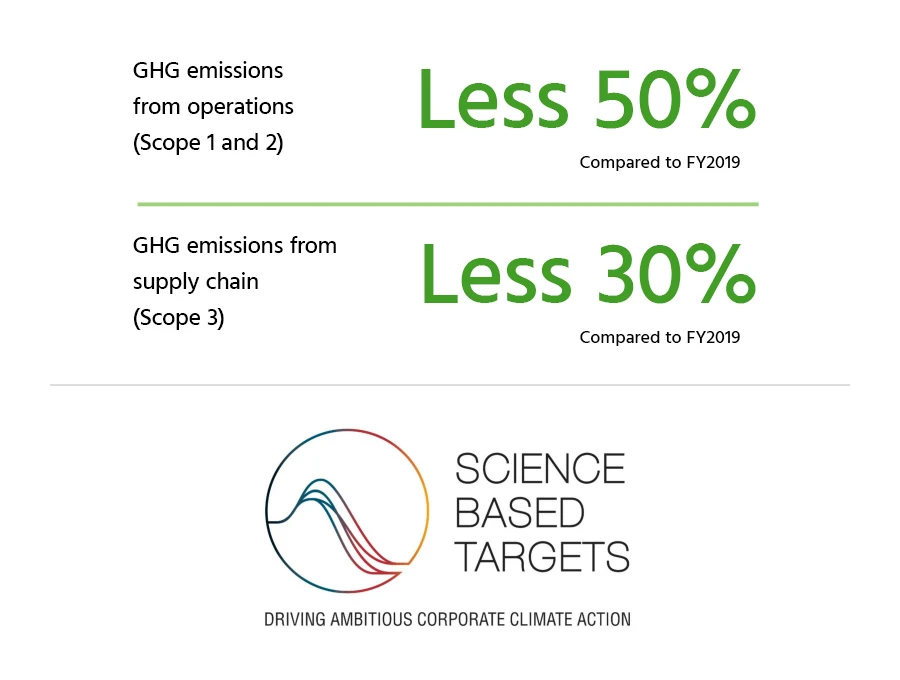
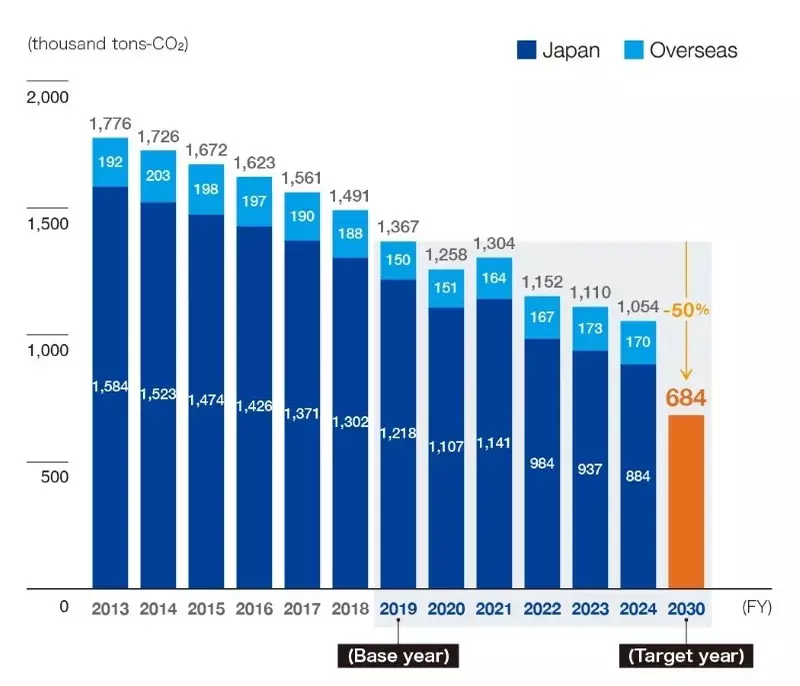
Toyo Seikan Group aims to significantly reduce GHG emissions and achieve carbon neutrality as a long-term goal for 2050. Therefore, the "Eco Action Plan 2030" sets GHG emission reduction targets for 2030 as follows.
This target has obtained certification for the "1.5°C Target" from the international initiative SBT (Science Based Targets).
Trends in GHG emissions from business activities (Scope 1, 2)
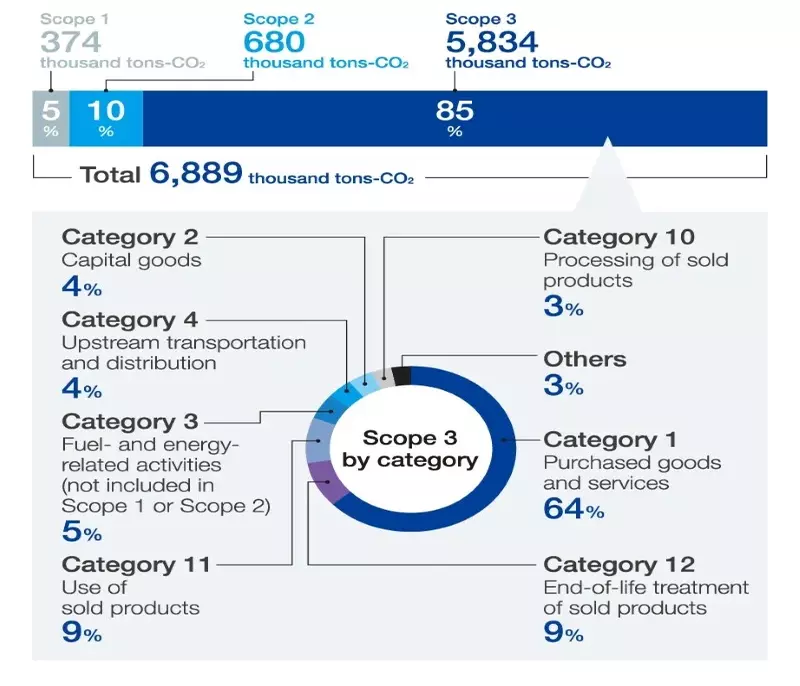
GHG emissions in the supply chain (FY2025)
Progress and evaluation of Eco Action Plan 2030
Evaluation indicators: ★★★ Goal achieved ★★ Goal slightly below target ★ Insufficient efforts
*The table can be scrolled left and right.
| 2030 goals (Eco Action Plan 2030) | Results for FY2025 (Main Initiatives) | evaluation |
|---|---|---|
|
Zero-Carbon Society |
||
|
|
★★★ |
|
|
★★ |
|
Zero-Waste Society |
||
|
|
★★ |
|
||
|
||
|
Society Coexisting with Nature |
||
|
|
★★★ |
|
|
★★★ |
- Exhaustible resources: Natural resources that cannot be replenished by natural processes at a rate faster than the rate at which they are used by humans and others.
- Fossil resources: oil, natural gas, etc.