

2026.08.05
Management and Business
Toyo Seikan Co., Ltd. Started demonstration of arteriologic linkage model for plastic (container and packaging) circular economy through collaboration among nine companies (Ministry of the Environment contracted project)
- Verification of the feasibility of a co-creation platform for the social implementation of peeling and deinking technologies -
Our consolidated subsidiary Toyo Seikan Co., Ltd. (Head Office: Shinagawa-ku, Tokyo; President and CEO: Yasumitsu Takebe; hereinafter "Toyo Seikan") will participate in the Ministry of the Environment's "2025 Plastic circular economy Strategy Survey and Review" model demonstration of the arterial and grass-based collaboration *1 model. In this project, nine companies involved in the circular economy of flexible packaging materials will participate, and multiple companies will advance the social implementation of peeling and deinking technologies, and we will verify the feasibility and conditions for establishing a co-creation platform (PF) model that jointly utilizes equipment and technology.
*1 This is an expression that likens economic activity to the circulation of blood: industries that process natural resources to manufacture and distribute products are called 'arterial industries,' while industries responsible for recirculating waste to society through collection, sorting, reuse, regeneration, and proper treatment are called 'venous industries.' Efforts to circulate resources through collaboration among these are called 'arterial and spinal collaboration.'
The circular economy of plastics is gaining global importance from the perspectives of resource depletion, waste reduction, and measures against marine plastic waste. In Japan as well, while collection and recycling are progressing based on the Plastic circular economy Strategy and the Plastic circular economy Act, expanding collection volumes, establishing advanced recycling technologies, and improving the quality and expanding the use of recycled plastics (hereafter "recycled materials") remain challenges.
To expand the use of recycled materials, it is essential to establish systems that simultaneously ensure quality, cost competitiveness, and stable supply. To address these challenges, the development of advanced material recycling technologies such as peeling and deinking has recently been progressing. On the other hand, for the social implementation of these technologies, not only the technology itself but also collaboration among businesses and the establishment of operational systems are important elements.
Against this backdrop, this demonstration will be conducted as part of the Ministry of the Environment's "FY2025 Plastic circular economy Strategy Survey and Consideration Project"*2. This demonstration will be conducted by Mitsubishi Research Institute Co., Ltd. as the overall supervisor, and in collaboration with nine major companies involved in the circular economy of plastic containers and packaging (flexible packaging materials), it will verify the feasibility of establishing a "co-creation platform (PF) model" in which multiple arterial and venous operators jointly utilize technology and equipment.
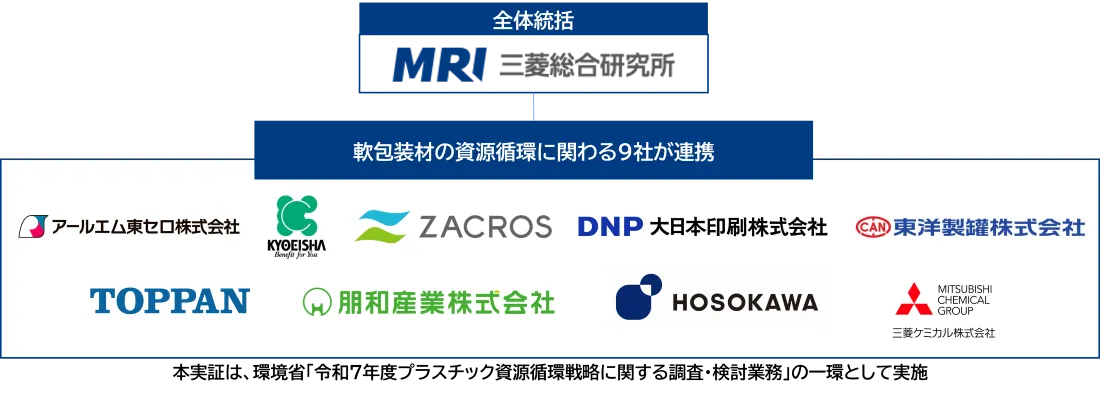
This demonstration project aims to verify the effectiveness and feasibility of a "collaborative platform model" in which multiple arterial and venous pipeline operators jointly utilize equipment and technology, with a view to the social implementation of peeling and deinking technology. In addition, the peeling and deinking technology used under the platform model will be demonstrated under common conditions, and challenges toward social implementation will be identified.
The distinguishing feature of this demonstration is that it does not aim to evaluate the performance or compare the superiority or inferiority of individual technologies, but rather to verify the feasibility and challenges of a collaborative platform model based on the joint use of equipment and technology, focusing on stripping and deinking technologies developed by multiple companies. Specifically, the following initiatives will be implemented.
We will compare the use of equipment and technology by individual companies with the joint use of equipment and technology under a collaborative platform model, and verify the effects on the quality, cost competitiveness, and supply stability of recycled materials. In addition, we will examine the entire supply chain from collection to recycling, clarifying the roles and collaborations of related businesses and operational challenges for the joint use of equipment and technology.
Regarding the peeling and deinking technologies being developed by multiple companies, we will conduct peeling and deinking treatments and evaluations using multiple common samples, and identify challenges and considerations for collaborative platform development. The common samples will be designed for flexible plastic packaging materials, taking into account market size and the significance of the demonstration, after discussions among the participating companies.

Toyo Seikan As a participating business operator in this demonstration, we will cooperate in providing samples and insights necessary for the demonstration, as well as in evaluating and verifying the results. Additionally, under the collaboration of nine companies, we will participate in examining a co-creation platform (PF) model that contributes to improving the quality of recycled materials, ensuring stable supply, and reducing costs, and will work to clarify its feasibility and operational challenges.
Toyo Seikan is working on developing technologies to improve the quality and utilization of recycled materials to expand the use of recycled plastics in flexible packaging. We believe that collaboration among arterial and vein suppliers is important to achieve improved quality, cost reduction, and stable supply of recycled plastics.
Going forward, we will organize the insights gained from this demonstration, clarify the conditions for establishing the co-creation PF model and operational challenges, and organize key points for social implementation, commercialization, and horizontal rollout. Based on the demonstration results, we will contribute to social implementation by considering circular economy policies to expand recycled plastic use and concretizing cross-industry initiatives.
*2 Mitsubishi Research Institute begins research and discussion on plastic circular economy strategy (Mitsubishi Research Institute Co., Ltd. News Release dated April 21, 2026)
https://www.mri.co.jp/news/press/20260421.html
Since its founding, Toyo Seikan Co., Ltd. has been a leading company dedicated to manufacturing packaging containers based on the importance of packaging, and has continued to supply the world with packaging containers that meet the values and needs of everyone.
Our company's mission is to "contribute to the happiness and prosperity of mankind" through packaging, which is a social infrastructure that supports everyday life.
We will strive to achieve our next leap forward by developing and providing high-value-added products and services that are unique to Toyo Seikan and that will satisfy our customers, thereby contributing to the development of society.