

Toyo Seikan Group
Materiality (important issues)


To contribute to the realization of a sustainable society, Toyo Seikan Group has identified priority issues to address as "Materiality (important issues) for Toyo Seikan Group."
In light of the medium- to long-term strategies and vision outlined in our Long-Term Management Vision 2050 "The Future, Wrapped for All" and Medium-Term Management Plan 2025, we have established the following six material issues.
*The table can be scrolled left and right.
| Materiality | Risks and Opportunities | KGI | Target year | FY2024 results and initiatives |
|---|---|---|---|---|
|
Developing and providing Products and services that support various lifestyles To achieve our goal of "responding to diversity" as outlined in our Long-Term Management Vision 2050, we will provide products and services that take into account the diversification of lifestyles and consumer needs, and contribute to solving social issues. |
Risk
Opportunity
|
Sales ratio of certified products and services |
2030 |
25.5% |
|
Developing and providing Developing and offering products and services that are environmentally sound To achieve the goal of "realizing a sustainable society" set out in our Long-Term Management Vision 2050, we will provide products and services that contribute to the global environment and contribute to solving social issues. |
Risk Loss of trust from stakeholders and relative inferiority to competitors due to delays in the development and provision of Developing and offering products and services that are environmentally sound Opportunity
|
|||
|
Contribution to the environment To implement various initiatives that contribute to reducing environmental impact to realize a decarbonized society, circular economy society, and a nature symbiotic society as outlined in the Eco Action Plan 2030. |
Risk Decline in competitive advantage due to delays in addressing various environmental issues such as GHG emission reductions and circular economy Opportunity
|
GHG emissions from business activities (Scope 1, 2) 50% reduction (compared to 2019) |
2030 |
22.9% reduction (compared to FY2019) |
| GHG emissions in the supply chain (Scope 3) 30% reduction (compared to 2019) |
2030 |
18.0% reduction (compared to FY2019) | ||
| Consumption of non-renewable resources 30% reduction (compared to 2013) |
2030 |
19.0% reduction (compared to FY2013) | ||
| Amount of fossil resources used in plastic products 40% reduction (compared to 2013) |
2030 |
23.8% reduction (compared to FY2013) | ||
| Water intake for business activities 1% improvement in unit of sales compared to the previous year |
2030 |
8.7% increase | ||
|
Respect for Human Rights Ensure that there are no human rights violations, such as discrimination, forced labor, or harassment, not only within your own company but throughout your supply chain, and strive to prevent such violations. |
Risk Reputational damage and sales declines due to human rights disputes and protests Opportunity Strengthening stable procurement by considering human rights throughout the supply chain |
Implementation rate of internal human rights due diligence 100% |
2030 |
|
| Due diligence implementation rate within the supply chain 100% |
2030 |
Toyo Seikan Group Holdings sent the Global Compact Network Japan (GCNJ) common SAQ (self-assessment questionnaire) to its suppliers, receiving responses from 178 companies. In addition to sending feedback sheets to all companies, the company also held discussions with some suppliers to confirm the current situation and to consider future improvements in the priority areas of human rights and labor. | ||
| Implementation rate of in-house human rights training 100% |
2025 | We implemented e-learning using educational materials based on the United Nations Guiding Principles on Business and Human Rights at all 41 applicable Group companies in Japan, and also implemented similar e-learning at 14 overseas Group companies, primarily in Thailand and Malaysia. | ||
|
Respect for Employees In addition to creating a rewarding work environment that takes safety, health, and diversity into consideration, we will secure and develop human resources who continue to take on challenges that lead to the creation of new value, thereby maintaining and improving our competitiveness. |
Risk
Opportunity
|
Ratio of female managers *1 More than 6% |
2030 | 5.8% (as of April 1, 2025) |
| Female hiring ratio *1 Over 30% |
2025 | 23.30% | ||
| Difference in average years of continuous employment between men and women *1 Within 3 years |
2025 | 3.2 years (18.3 years for men, 15.1 years for women) (As of March 31, 2025) |
||
| Percentage of employees hired in the 10th fiscal year and the fiscal years before and after that who are continuously employed by gender *1 Over 70% |
2025 | 58.7% male, 48.7% female (total 57.1%) (As of March 31, 2025) |
||
| EBITDA per person *2 Over 5.5 million yen |
2025 | 4.79 million yen | ||
| Engagement *1,3 52.7 or higher |
2025 | 50.9 | ||
| Dissemination of the Group's philosophy and vision *1,4 Over 80% |
2025 | 55.0% | ||
| Overall health risk *1,3 Under 100 |
2025 | 102 | ||
| A workplace where you can grow *1,3 52.9 or higher |
2025 | 51.9 | ||
| Ratio of core personnel with experience at other group companies *1 Over 60% |
2025 | 59.0% | ||
| Number of people exceeding 45 hours after hours *1,5 2.7 people |
2025 | 4.9 people | ||
|
Thorough compliance In addition to complying with laws, regulations, corporate ethics and standards, we will take measures to prevent corruption and anti-competitive behavior. |
Risk Sluggish business activities, loss of social credibility, and damage to corporate value due to compliance violations Opportunity
|
Compliance with laws, regulations, corporate ethics, and standards |
- Target companies: Toyo Seikan Group Holdings, Toyo Seikan, Toyo Kohan, Tokan Kogyo, Nippon Closures, Mebius Packaging, TOYO GLASS
- Calculated by dividing consolidated EBITDA by the number of consolidated employees
- Measurements are taken using the "HoPE Survey" provided by Hoken Dojin Frontier Co., Ltd. Additionally, "a workplace where you can grow" is an index that measures whether or not a workplace is one in which employees can visualize their own career advancement and growth, and can be involved autonomously and independently.
- The percentage of employees who answered "I understand" or "I understand to some extent" the Group's philosophy and vision
- The average number of incidents per 100 people per month in each fiscal year is calculated, excluding management positions.
Materiality Identification Process
Issues
extraction
- Based on guidelines such as GRI and SASB, the Medium-Term Management Plan 2025, and industry issues, Toyo Seikan Group will extract and create a long list of priority issues.
- Similar issues were aggregated and integrated to create a list of 19 themes
Priority
Add
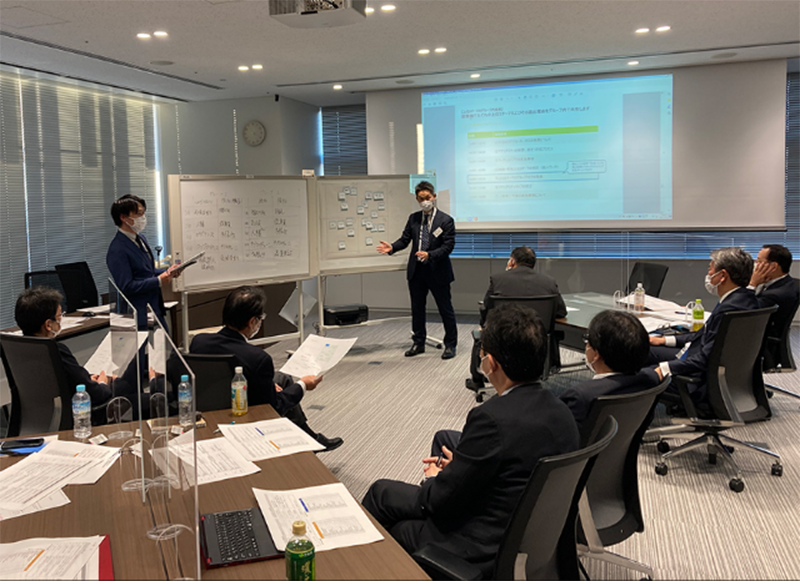
- Considering consistency with management philosophy and evaluation of each issue in workshops with operating company executives, etc., we carefully examine the importance to Toyo Seikan Group
- Carefully examine the importance to stakeholders based on information such as important issues in the container and packaging industry and important ESG themes that institutional investors expect companies to address.
- Selecting candidates for important issues (materiality) for Toyo Seikan Group
Materia
Rity's
identification
- The identification process and materiality candidates are reviewed by external experts to confirm their validity
- Identifying materiality for Toyo Seikan Group through a resolution process at the Board of Directors meeting
Materiality Matrix
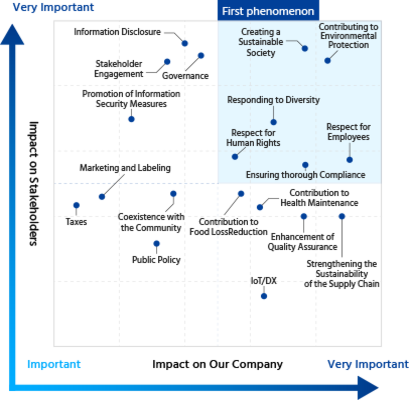
Materiality
- Developing and providing Products and services that support various lifestyles
- Developing and providing Developing and offering products and services that are environmentally sound
- Contribution to the environment
- Respect for Human Rights
- Respect for Employees
- Thorough compliance
The theme integrates "climate change," "environmental contribution through efficient resource use," and "biodiversity."
Materiality assessment and review
To more effectively promote our sustainability initiatives and ensure sustainable growth in our corporate value, we annually report and evaluate progress on materiality at Group Sustainability Committee. The progress and evaluation results by Group Sustainability Committee are reported to the Board of Directors, who confirm their validity. In addition, by reviewing materiality for each period of our medium-term management plan, we respond to social, environmental, and economic changes and keep our business strategy and sustainability initiatives up to date.
Toyo Seikan Group 's initiatives and their relationship with the SDGs
Toyo Seikan Group provides a variety of products and services related to the SDGs and is engaged in sustainability initiatives.
To further promote these efforts, we organized the main goals for each important ESG theme, extracted materiality (important issues), and verified the relevance of Toyo Seikan Group 's initiatives in light of the 17 goals and 169 targets of the SDGs.
Key comments from exchanges of opinions with external experts
Executive Fellow, Research Institute for Capital Investment, Development Bank of Japan Inc.
Keisuke Takegahara
He graduated from the Faculty of Law at Hitotsubashi University in 1989 and joined the Japan Development Bank (now the Development Bank of Japan Inc.) in the same year. He has held various positions, including Chief Representative in Frankfurt, Director of the Environment & CSR Department, Director of the Industrial Research Department, and Executive Officer and Deputy Director of the Industrial Research Division, before assuming his current position in 2021. He has long been involved in planning in the field of environmental finance, including the establishment of DBJ Environmental Rating Loans. He has held numerous public positions, including as a member of the Ministry of Economy, Trade and Industry's Study Group on Guidelines for Disclosure of Non-Financial Information, a member of the Ministry of Education, Culture, Sports, Science and Technology's Review Committee on Climate Change Research (since 2021), and an ad hoc member of the Ministry of the Environment's Central Environment Council. His co-authored books include "Renewable Energy and New Growth Strategies" (Energy Forum/2015) and "How Should We Deal with Climate Change Risks?" (co-authored with the Financial and Fiscal Affairs Research Institute/2014).
The materiality issues were selected as the issues to be addressed in the Medium-Term Management Plan 2025, which was backcast from the Long-Term Management Vision 2050, "The Future, Wrapped for All," formulated after extensive discussions among employees at each Group company. They serve as the initial direction for the long-term vision, moving toward the goal of the plan through the milestone of the Medium- to Long-Term Management Target 2030, under a solid timeline. The "offensive" areas correspond to the Group's goals set out in the Long-Term Vision: "Developing and providing Products and services that support various lifestyles" and "Developing and providing Developing and offering products and services that are environmentally sound" The selection of items is clear: "Environment" and "Human Rights" are identified as areas of defense to avoid negative impacts in achieving these goals, with "Employees (Human Capital)" and "Compliance" positioned as fundamental elements. The process is also carefully implemented, with detailed analysis of internal and external issues and deep involvement from management. Because the level of abstraction is high, further ingenuity is expected in the subsequent KPI selection process and the process of disseminating information to group employees in order to convince readers of the "uniqueness" behind the specific tasks, including the high level of the specific tasks.
Representative Director, Global Compact Network Japan (GCNJ)
Toshio Arima
Graduated from the College of Liberal Arts at International Christian University in 1967. Joined Fuji Xerox in the same year. In 1988, he became General Manager of the Corporate Planning Department.
He became CEO of Xerox International Partners in the US in 1996, President and Representative Director of Fuji Xerox in 2002, and Special Advisor and Senior Counselor in 2008, retiring in 2012. During his time as President, he promoted management reforms and also worked hard on CSR management, including launching the concept of "Corporate Quality." He became Representative Director of GCNJ in October 2011. He also served as a board member of the United Nations Global Compact from July 2007 to the end of June 2018, and continues to work towards building a sustainable society.
Your company's appropriate identification process, based on guidelines from the Global Reporting Initiative (GRI) and Sustainable Accounting Standards Board (SASB), is entirely appropriate. Used packaging becomes a huge waste stream, contributing to problems such as marine plastic waste. Your Long-Term Management Vision 2050, "The Future, Wrapped for All," outlines a business model transformation from "packaging manufacturing" to "Daily Living Platform." I believe the "circular economy of packaging" occupies an important position, given its social significance and potential for new business opportunities. While you've already touched on this, I think it deserves more attention. Furthermore, the SDG Compass, a set of corporate action guidelines for the SDGs jointly issued by the UNGC, GRI, and WBCSD, encourages global companies to take an "outside-in" approach, stepping outside their own business domains to address a wide range of global and societal challenges. I hope you will broaden the scope of your materiality identification efforts going forward, both to maximize your company's capabilities and to explore new business opportunities.