

Mitsubishi Chemical Corporation, Nippon Polyethylene Co., Ltd., Nippon Polypro Co., Ltd., RM Tosero Co., Ltd., Kanaoka Holdings Co., Ltd., Dai Nippon Printing Co., Ltd., Toyo Seikan Group Holdings, Ltd., Mitsui & Co., Ltd., Mitsui & Co. Distribution Group Co., Ltd., and REFINVERSE, Inc. have conducted demonstrations of circular economy systems in metropolitan areas through the Ministry of Economy, Trade and Industry's 'FY2025 Demonstration Project for circular economy System Construction in Wide-Area Municipalities,' and have now completed the demonstration.
In this project, we built and verified circular economy models across the supply chain, taking into account the unique emission characteristics and infrastructure conditions of each region, in collaboration with businesses and local governments. As a result, we organized the required recycling methods for each regional type, the nature of wide-area collaboration, and the challenges and directions for expanding the use of recycled materials.
In recent years, the transition to a circular economy has accelerated to address global resource constraints and environmental issues. In Japan as well, while efforts to realize a resource-autonomous economy are progressing, the expansion of recycled materials and the establishment of regional circulation systems are still in progress, making further collaboration among municipalities and the development of advanced schemes for sorting, collection, and recycling as challenges.
The Ministry of Economy, Trade and Industry is advancing various measures to build a wide-area circular system and ensure the stable supply of recycled materials. Mitsubishi Research Institute Co., Ltd. (President: Kenji Yabuta) was selected as the contractor for the above project, and Mitsubishi Chemical, Nippon Polyethylene, Nippon Polypro, RM Tosero, Kanaoka Holdings, Dai Nippon Printing, Toyo Seikan Group Holdings, Mitsui & Co., Mitsui & Co. Distribution Group, Ten companies from the Refinverse (hereafter, the 10 collaborating companies) participated in the demonstration in the metropolitan area.
Demonstration Start News Release
(References) Mitsubishi Chemical, Nippon Polyethylene, Nippon Polypro, Kanaoka Holdings, Dai Nippon Printing, Toyo Seikan Group Holdings, Mitsui & Co., Mitsui & Co. Distribution Group, Refinverse, and 'FY2025 Demonstration Project for circular economy System Construction in Wide-Area Municipalities'
https://www.tskg-hd.com/news/detail/20251104_newsrelease.html
* RM Tocello Co., Ltd. was confirmed to participate after the above announcement.
(Reference) Mitsubishi Research Institute launches 'FY2025 Demonstration Project for circular economy System Construction in Wide-Area Municipalities'
https://www.mri.co.jp/news/press/20251021.html
In the demonstration project involving 10 partner companies, from September 2025 to the end of February 2026, waste plastics such as offcuts (polyethylene film for food containers and packaging, PE caps, pre-printed polypropylene (PP) film) generated at the factories of Kanaoka Holdings, Toyo Seikan Group Holdings, and Dai Nippon Printing were collected by Mitsui & Co., Mitsui & Co., Mitsui & Co. Distribution Group, and Refine Verse. After pretreatment at Refineverse, Mitsubishi Chemical chemically recycled (oilified) the waste plastics that met acceptance standards. The chemically recycled naphtha obtained was converted into ethylene, propylene, and other materials, and using these as raw materials, we produced chemically recycled polyethylene (hereafter, CRPE) at Nippon Polyethylene and chemically recycled polypropylene (hereafter, CRPP) at Nippon Polypro. After checking the quality * of CRPE and CRPP, no significant differences were observed compared to PE and PP made from petroleum-derived raw materials, and it was determined that their basic physical properties were at a comparable level. Furthermore, using these as raw materials, RM Tosero, Kanaoka Holdings, Toyo Seikan Group Holdings, and Dai Nippon Printing experimentally produced food container and packaging materials (flexible packaging and bags). As a result, flexible packaging materials using CRPE and CRPP showed no significant differences in physical properties or functionality compared to those made from petroleum-derived PE and PP. From the perspective of quality characteristics required for food container and packaging applications, it was determined that both have equivalent performance in terms of basic physical properties.
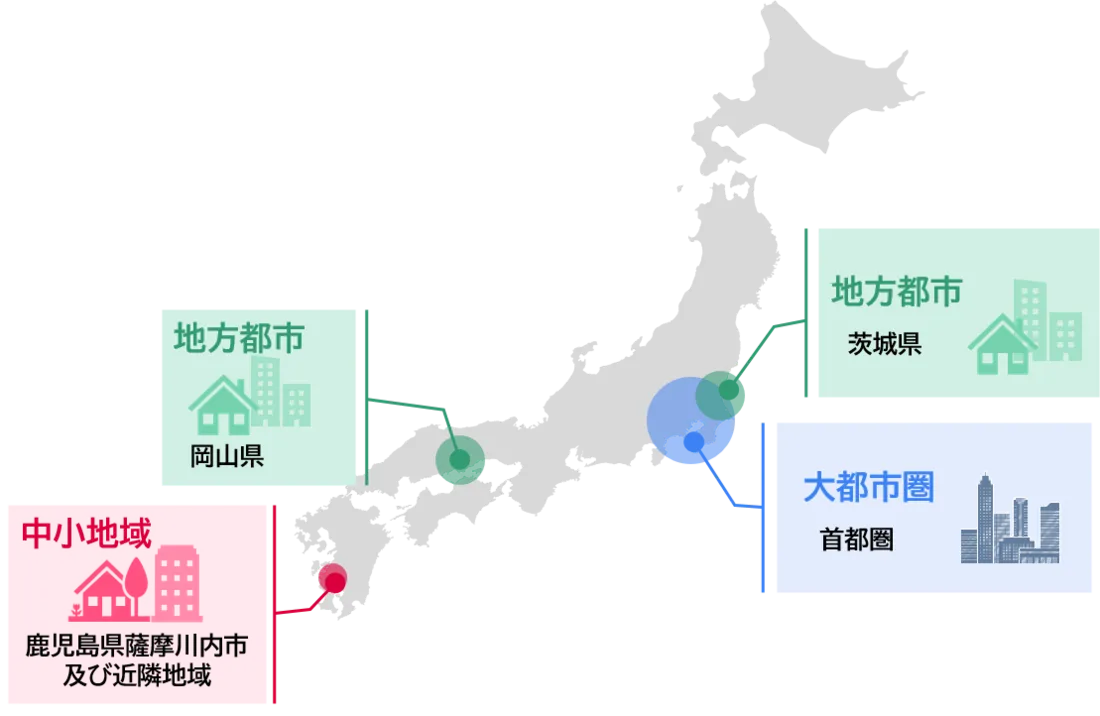
For detailed information on the entire demonstration project, including the results of demonstration projects in regional cities and small to medium-sized regions, please refer to the report published on the Ministry of Economy, Trade and Industry website dated May 28, 2026.
(Reference) FY2025 'Project to Establish a Resource-Autonomous Economy and Accelerate Industry-Government-Academia Collaboration (Demonstration Project for Building circular economy Systems in Wide-Area Municipalities)' Report
https://www.meti.go.jp/meti_lib/report/2025FY/report_202605260713_0.pdf
* This initiative adopts the mass balance method. The mass balance method is a method in which petroleum-derived raw materials and chemical recycled raw materials are mixed to create products, assigning properties to parts of the product according to the amount of recycled material added.

*The table can be scrolled left and right.
| business operator | Primary Role | Overview/Activities |
|---|---|---|
| Mitsubishi Chemical Corporation | recycling | We convert waste plastics into oil through chemical recycling and manufacture basic chemicals. I am responsible for overseeing the entire scheme. |
| Nippon Polyethylene Co., Ltd. Nippon Polypropylene Co., Ltd. |
Resin manufacturing | Polyethylene/polypropylene is manufactured using basic chemicals obtained through oil conversion. |
| RM Tosero Co., Ltd. | Manufacturing of containers and packaging materials | We manufacture and evaluate container and packaging materials. |
| Kanaoka Holdings Co., Ltd. Dai Nippon Printing Co., Ltd. Toyo Seikan Group Holdings, Ltd. |
Supply of waste plastics and manufacturing of containers and packaging. | In addition to providing waste plastics discharged from factories, we also manufacture and evaluate containers and packaging. |
| Mitsui & Co., Ltd. Mitsui & Co. Distribution Group Co., Ltd. |
Collection of waste plastics | Responsible for collecting and transporting waste plastics. |
| REFINVERSE, Inc. | Collection and pretreatment of waste plastics | We collect waste plastics, perform pre-processing such as deinking and sorting, and then supply them to the recycling process. |
Economic evaluations based on the assumption of social implementation revealed that the price of CRPE and CRPP could be 2 to 3 times higher than that of petroleum-derived PE and PP, depending on preconditions such as manufacturing scale. Furthermore, food containers and packaging that partially use CRPE and CRPP could be manufactured at approximately 1.5 times the price of those using petroleum-derived PE and PP, depending on preconditions such as blending ratio and layer composition.
To expand the use of recycled materials, it is necessary to establish an efficient system for collecting used plastics, develop pre-treatment technologies to broaden the acceptance standards for used plastics, and further advance chemical recycling technologies. The 10 collaborating companies will leverage the knowledge gained from this demonstration project to promote initiatives for the effective use of used plastics and contribute to the realization of a sustainable society.