

Respect for Employees : Human Capital Initiatives


Toyo Seikan Group is working as a unified group to promote the development and active participation of human resources. In 2018, we established the Toyo Seikan Group Personnel Policy to realize our management philosophy, and have been working to improve our internal environment based on four pillars: "Achieving autonomous growth (human resource development)," "Co-creation of diverse human resources," "Workstyle reform," and "Health and productivity management." In 2023, we formulated a human resources development policy and an internal environment improvement policy with the aim of strengthening the group's overall strength and linking human capital management to improving corporate value. We will improve corporate value by expanding human capital.
Human Resources Development Policy
Group management and organizational strategies
The basis of our management strategy is to "maintain existing business areas while expanding profits in new business areas by making maximum use of the Group's resources." To realize this strategy, we transitioned to a holdings structure in 2013 and have since (1) established and expanded strategic departments, (2) consolidated and integrated operational tasks, and (3) established a governance system. In 2021, we formulated our "Long-Term Management Vision 2050: The Future, Wrapped for All," and are currently working to spread this vision among our employees.
Desired talent profile
The types of talent needed to realize the above management and organizational strategies can be broadly divided into the following three categories.
- Talent who can maintain and continue the operation of existing businesses at a high level (in terms of quality, cost, delivery time + ESG)
- Talent who are familiar with the operations of existing businesses and can build new systems from the perspective of optimizing the entire group
- Talent who can utilize the group's resources to create new products, technologies, and businesses
After securing personnel in category ①, the challenge is how to increase personnel in categories ② and ③ ("group personnel").
Human Resources Strategy
The human resources strategies for developing the above talent are summarized below.
- By promoting human resource management based on the Group's personnel policy, we aim to improve employee engagement and productivity.
- Creating an environment to secure human resources for the manufacturing sector
- Regarding regular recruitment of university graduates at major group companies, we will continue to recruit all employees at once across the group, aiming to strengthen our competitiveness in recruitment and raise awareness of the group.
- Promote group awareness and foster new perspectives through collaboration and personnel exchanges that transcend company boundaries
- Actively recruiting mid-career talent with diverse knowledge
KPI
The KPIs for realizing our HR strategy are summarized below.
*The image can be scrolled left and right.
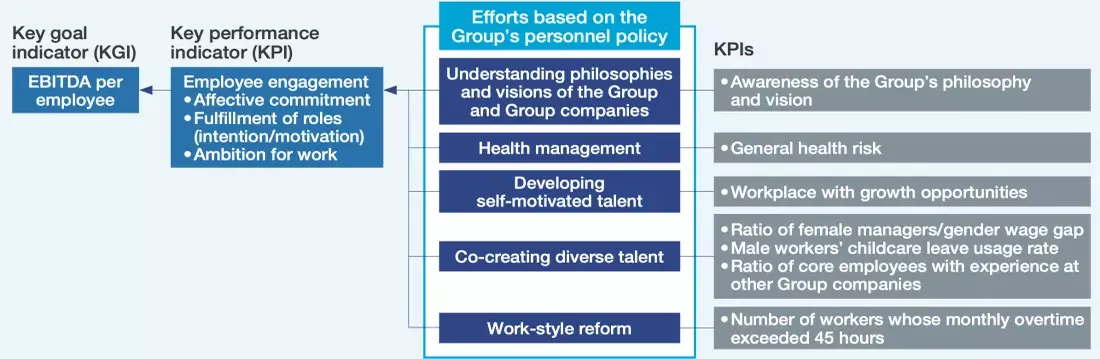
Scores for "Engagement," "Overall Health Risk," and "Workplace Growth" are measured using the "HoPE Survey" by Hoken Dojin Frontier Co., Ltd. "Engagement" is measured from three perspectives: "Attachment to the organization," "Fulfilling one's role (will and motivation)," and "Ambition for work."
As a correlation can be seen between many KPIs, such as "EBITDA per capita" and "engagement," at each group company, we plan to continue efforts based on the group's human resources policy and improve each KPI, thereby improving "EBITDA per capita," which is our KGI.
Indicators and targets for the materiality "Respect for Employees"
- The table can be scrolled left and right
| Materiality items | KGI | Target year | Achievements | ||
|---|---|---|---|---|---|
| FY2022 | FY2023 | FY2024 | |||
| Ratio of female managers *1,3 | More than 6% | 2030 | 3.4% | 4.4% | 5.8% |
| Female hiring ratio *3 | Over 30% | 2025 | 22.4% | 17.5% | 23.3% |
| Difference in average years of continuous employment between men and women *2,3 | Within 3 years | 2025 | 3.4 years (18.7 years for men, 15.3 years for women) |
3.1 years (18.3 years for men, 15.2 years for women) |
3.2 years (18.3 years for men, 15.1 years for women) |
| Percentage of employees hired in the fiscal years prior to and following the 10th fiscal year who are continuously employed by gender *2,3 | Over 70% | 2025 | 64.5% male, 50.0% female (Overall 61.8%) |
62.3% male, 50.5% female (Overall 60.5%) |
58.7% for men, 48.7% for women (Overall 57.1%) |
| EBITDA per person *4 | Over 5.5 million yen | 2025 | 3.02 million yen | 4.54 million yen | 4.79 million yen |
| Engagement *3,5 | 52.7 or higher | 2025 | 50.7 | 50.8 | 50.9 |
| Dissemination of the Group's philosophy and vision *3,6 | Over 80% | 2025 | - | 51% | 55% |
| Overall health risk *3,5 | Under 100 | 2025 | 103 | 103 | 102 |
| A workplace where you can grow *3,5 | 52.9 or higher | 2025 | 51.9 | 51.8 | 51.9 |
| Ratio of core personnel with experience at other group companies *3 | Over 60% | 2025 | 54.6% | 59.1% | 59.0% |
| Number of people exceeding 45 hours after hours *3,7 | 2.7 people | 2025 | 5.7 people | 5.0 people | 4.9 people |
- As of April 1st of each following fiscal year
- As of March 31 of each fiscal year
- Target companies: Toyo Seikan Group Holdings, Toyo Seikan, Toyo Kohan, Tokan Kogyo, Nippon Closures, Mebius Packaging, TOYO GLASS
- Calculated by dividing consolidated EBITDA by the number of consolidated employees
- Measurements are taken using the "HoPE Survey" provided by Hoken Dojin Frontier Co., Ltd. Additionally, "a workplace where you can grow" is an index that measures whether or not a workplace is one in which employees can visualize their own career advancement and growth, and can be involved autonomously and independently.
- This is the percentage of employees who answered that they "understand" or "understand to some extent" the Group's philosophy and vision. Disclosure will begin from fiscal 2023 results.
- The average number of incidents per 100 people per month in each fiscal year is calculated, excluding management-level employees.
Particularly important issues for realizing HR strategies
We recognize four particularly important issues: "Improving engagement in the manufacturing department," "Improving engagement among employees in their 30s," "Increasing the ratio of female managers and eliminating the gender wage gap," and "Improving group awareness and the rate of personnel mobility within the group."
① Improving engagement in the manufacturing department
As we approach 2050, the year we have set out in our "Long-Term Management Vision 2050: The Future, Wrapped for All" we expect a significant decline in the 18-year-old population in Japan, while at the same time, the rate of university enrollment will rise, resulting in a significantly lower number of young people graduating from high school and entering the workforce than at present. To continue the Group's business under these circumstances, it is important to reduce turnover rates and strengthen recruitment competitiveness by improving employee engagement in the manufacturing division. Because engagement is strongly correlated with long working hours and physical strain, we will work to reduce physical strain through labor-saving investments, such as reviewing shift schedules to eliminate long working hours and considering automating night shift lines.
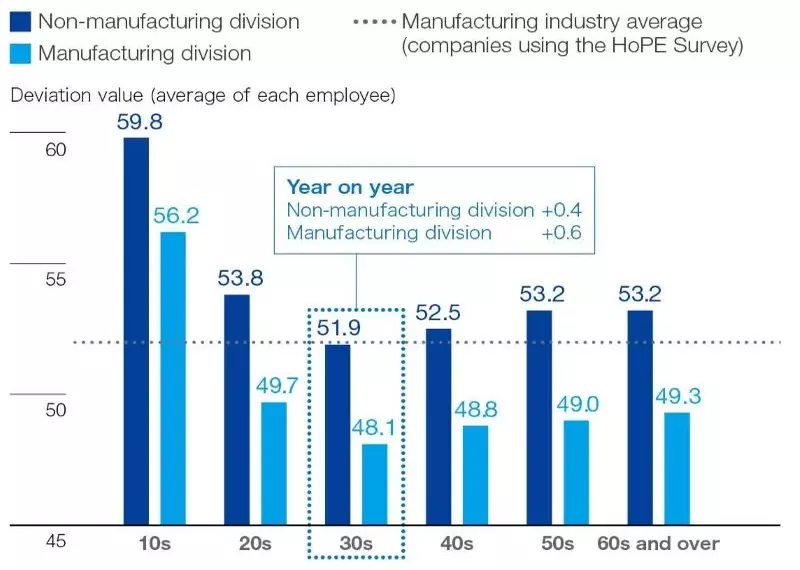 Engagement by department and age group for our group (7 companies) (FY2024)
② Improving engagement among employees in their 30s
When analyzing employee engagement by age group, people in their 30s tend to have lower levels than other age groups. This is thought to be due in large part to the fact that, compared to people in their 20s, the psychological burden (volume) of work increases, while support from superiors and colleagues decreases, resulting in a lower sense of growth.
As a countermeasure, we have implemented career training and career consulting interviews for employees in their 30s and their superiors. We have also unified our personnel systems from company-specific to group-wide, and are promoting promotions by selecting employees for promotion, thereby increasing the fairness and consistency of our career support.
We are also considering expanding the open recruitment system within the group and self-reporting of career paths.
③ Increase the ratio of female managers and eliminate the gender wage gap
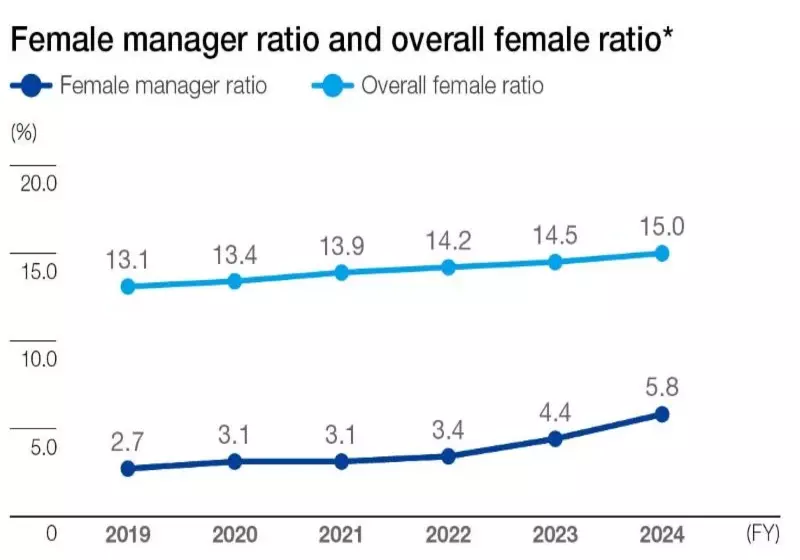
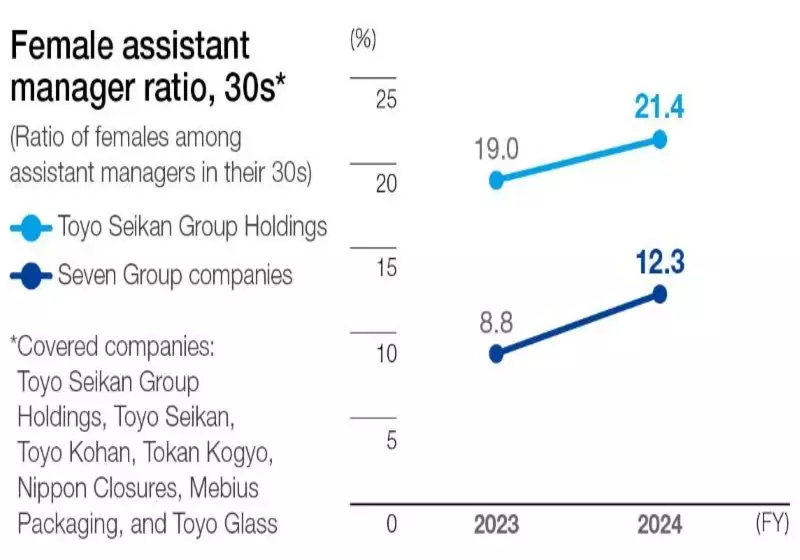
Ratio of female managersWe have set a target of achieving a female managerial ratio of over 6% at seven Group companies by fiscal 2030, and are working to improve this. The female managerial ratio at the seven Group companies will reach 5.8% in fiscal 2024, a gradual increase from 2.7% in fiscal 2019. Measures to improve female hiring and retention rates are beginning to bear fruit, with an increase in women in their 30s and older at section chief level, leading to changes in our corporate culture. Last fiscal year, we established a Diversity Promotion Subcommittee under the Human Rights and DE&I Promotion Subcommittee. In addition to sharing good practices and proposing measures, we aim to improve diversity across the Group through interactions among participating members. In fiscal 2024, we sent messages from the presidents of each Group company to Group employees via our intranet to raise employee awareness and engagement.
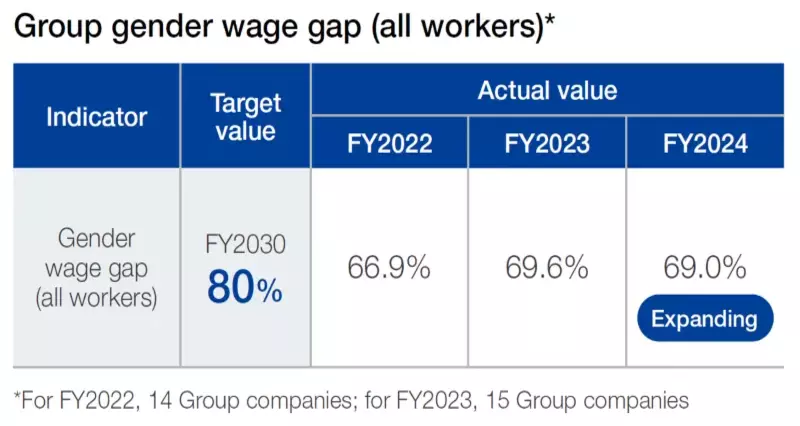
The gender wage gap for fiscal 2024 will be 69.0% on average across the 15 group companies. Looking at the wage categories for full-time employees, the gap in basic salary remains around 90% for both managerial and non-managerial positions, but the gap is widening in the wage categories of family and housing allowances and overtime and shift allowances. In addition, due to the low ratio of female managers, the gender wage gap for all full-time employees is larger than the gender wage gap between managerial and non-managerial positions.
To achieve future improvements, we plan to continue working to eliminate the gender wage gap by increasing the hiring and retention rate of female full-time employees and promoting them to higher positions and grades (expanding career development for internally promoted employees and mid-career hiring of managers), reviewing the requirements for payment of family and housing allowances, and correcting long working hours for male employees.
Gender wage gap by wage category for full-time employees (total of 15 major group companies)
*The table can be scrolled left and right.
| Basic salary | Family and housing allowances | Overtime and shift allowance | Total | |
|---|---|---|---|---|
| Management position | 91.0% | 19.3% | 43.1% | 89.5% |
| Non-management position | 90.1% | 33.0% | 43.8% | 77.7% |
| Total full-time employees | 82.0% | 33.5% | 49.9% | 74.7% |
- These figures are calculated based on March 2025 salary (single month).
- Basic salary refers to role-based pay, skill-based pay, age-based pay, qualification pay, position allowance, position allowance, qualification allowance, work allowance, etc.
- Family and housing allowances include family (support) allowance, housing allowance, single-person relocation allowance, urban allowance, and cold region (fuel) allowance.
- Overtime and shift allowances include early-morning overtime allowances, late-night allowances, holiday work allowances, allowances for over 60 hours, night shift allowances, late-start allowances, shift work allowances, and staggered work allowances. Overtime and shift allowances for managers include late-night allowances.
④ Improve group awareness and the rate of personnel mobility within the group
To realize the Group's management strategy, it is necessary to raise employee awareness of the Group and promote human resource mobility. With this in mind, we have set KPIs for "degree of penetration of the Group's philosophy and vision" and "ratio of core personnel with experience at other Group companies." Core personnel refer to future leadership candidates selected from major Group companies. We will increase the rate of human resource mobility by promoting penetration of the Group's long-term management vision, which was formulated in 2021, and by developing job-specific personnel plans across the Group.
Internal Environment Improvement Policy
- The Group has implemented the Next Generation Management Development Training and the Toyo Seikan Group Business College (TSGBC) for general managers and section managers at major companies, standardized personnel systems, and developed IT infrastructure (talent management systems, stress check systems, etc.). Starting with the fiscal year 2021 recruitment, we are switching from regular recruitment of university graduates at major group companies to collective recruitment across the group, with the aim of securing excellent human resources and developing leaders who will lead the group.
- In the future, in accordance with our human resource development policy, we will review our shift schedule, invest in labor-saving measures, implement career training by age group, expand our open recruitment system and self-reporting of careers, review the requirements for payment of family and housing allowances, and create personnel plans by job type.