

Respect for Human Rights


Toyo Seikan Group Human Rights Policy
The Toyo Seikan Group’s Management Philosophy, launched in 2016, states that the Group will aspire to achieve a sustainable society and contribute as a group to people’s happiness. We understand that respect for human rights across our business activities is a prerequisite for realizing this philosophy.
Accordingly, we have formulated the Toyo Seikan Group Human Rights Policy (the “Policy”) as our guide to promote respect for human rights and to fulfill our responsibility. The policy is in accordance with the United Nations Guiding Principles on Business and Human Rights.
In preparing the Policy, we conducted a “quantitative survey on human rights issues” based on the human rights risk database of Verisk Maplecroft, a global risk assessment and analysis firm. We performed quantitative impact assessments by business domains and by countries across ten human rights issues closely related to our operations. As a result, we confirmed that the industry risk levels in the business domains in which the Toyo Seikan Group operates are generally medium to low. In addition, we conducted surveys—mainly interviews with stakeholders within the Group—to identify potential human rights issues in the supply chain and stakeholders closely related to those issues, and used the findings to formulate the Policy.
At the same time, however, we acknowledge that it is not possible to completely eliminate the risk that our business activities may have adverse impacts on human rights. With this understanding, we will earnestly address such issues and work to ensure greater respect for human rights.
Each company within the Toyo Seikan Group will conduct impact analysis and evaluation on human rights and translate them into specific initiatives.
Toyo Seikan Group Human Rights Policy
1. Scope of Application
The Policy applies to all directors, auditors, officers and employees working within the Group. We also expect all business partners who are associated with the Group’s products, systems and services to comply with the Policy.
2. Basic Perspective
We promote our commitment to respecting human rights based on the United Nations Guiding Principles on Business and Human Rights, with our support and high regard for the following international rules and agreements related to human rights.
- The United Nations International Bill of Human Rights (consisting of the Universal Declaration of Human Rights, the International Covenant on Economic, Social and Cultural Rights, and the International Covenant on Civil and Political Rights)
- The International Labour Organization’s Declaration on Fundamental Principles and Rights at Work
- The United Nations Declaration on the Rights of Indigenous Peoples
3. Responsibility to Respect Human Rights
We will not infringe on the human rights of those affected by our business activities, and if an adverse human rights impact occurs through our operations, we will take appropriate action to remedy the situation. This is the way we fulfill our responsibility to respect human rights and build a responsible supply chain.
4. Human Rights Due Diligence
We establish a human rights due diligence process to identify, prevent and mitigate actual or potential adverse impacts on human rights.
5. Communication and Consultation
While implementing the Policy, we have honest communication and consultation with our stakeholders, drawing on independent external expertise in human rights.
6. Education and Training
We provide appropriate education and training so that the Policy is embedded throughout our business operations and effectively implemented across the Group.
7. Remediation
If our own activities cause adverse human rights impacts, or if it becomes clear that we are involved with adverse human rights impacts through our business relationships, we will provide remedies to redress the harm through communication and appropriate procedures based on international standards.
8. Director in Charge of Policy Implementation
We officially designate a director in charge of the Policy implementation and oversee the progress of the implementation.
9. Disclosure
We disclose the information on the progress and results of our human rights-related activities on our website and through other media.
10. Applicable Laws
We comply with laws and regulations of countries and regions where we operate. If there is any conflict between internationally recognized human rights and laws and regulations of a country or region, we will seek ways to honor international human rights principles to the greatest extent possible.
Japanese, Thai and Chinese versions are also available for employees of foreign group companies to understand and comply with the Human Rights Policy.
Major Human Rights Risks in Toyo Seikan Group
The Toyo Seikan Group's Code of Conduct explicitly states: "We will understand and respect the laws and regulations of the countries where we do business and international standards for human rights and will never violate human rights in every aspect of our business." It further states: "We promise to understand the Toyo Seikan Group Human Rights Policy and to always pay attention to whether or not we negatively impact human rights in all the business activities we are engaged in."
The typical human rights risks recognized by the Toyo Seikan Group include the following:
- Forced labor
- Child labor
- Freedom of association and the right to collective bargaining
- Any form of discrimination in employment and occupation
- Safe and healthy working conditions
- Wages (preventing unpaid wages, ensuring fair wages above the legal minimum wage, and promoting equal pay for equal work)
- Proper working hours
- Human rights in the supply chain
- Rights of foreign workers
- Human rights of indigenous peoples and local communities
Promotion Structure
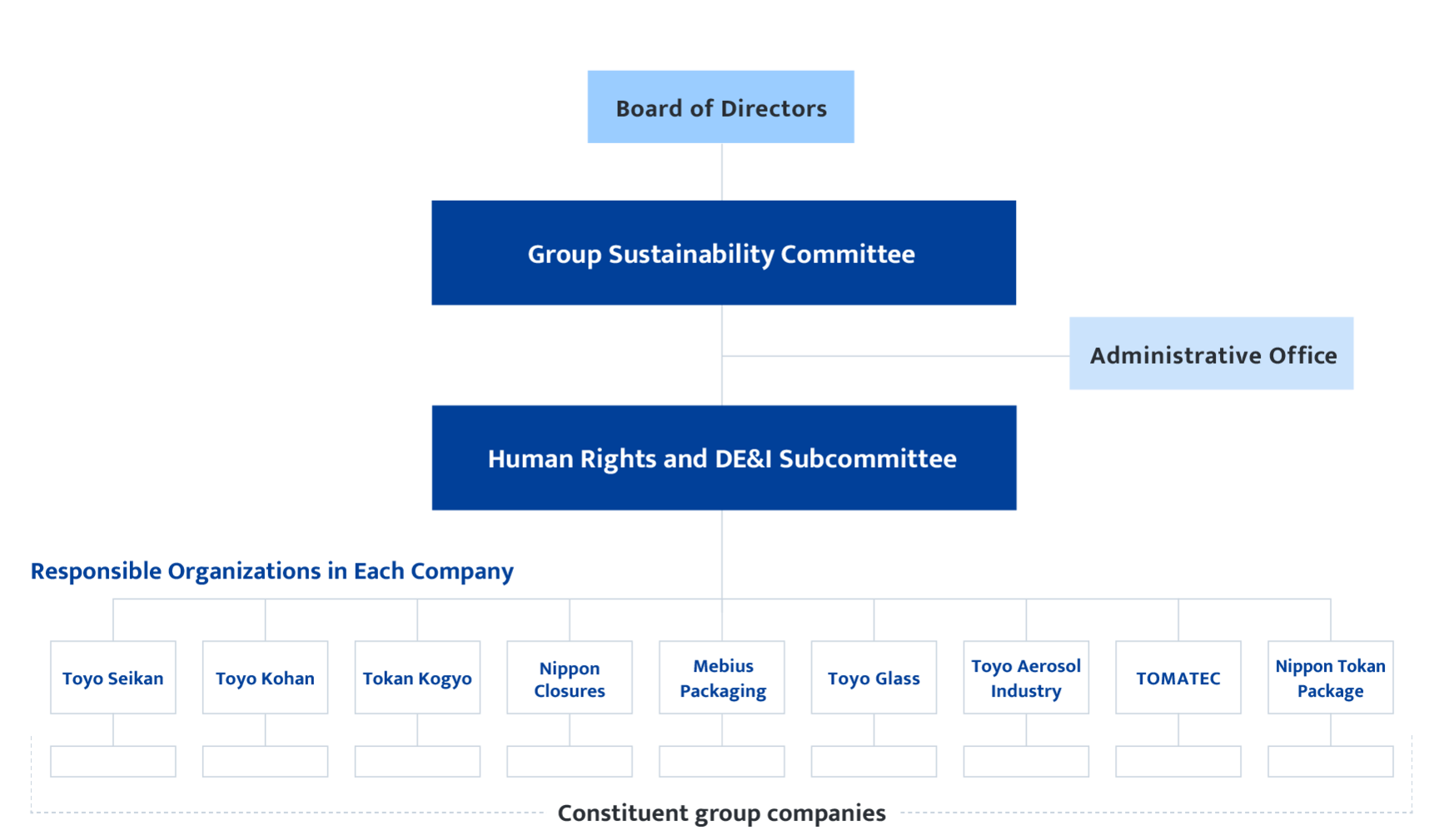
The Toyo Seikan Group has established the "Group Sustainability Committee" to promote sustainability management across the group.
From fiscal year 2023, the Group set up subcommittees for each element of ESG (Environment, Social, Governance). One of these is the Human Rights and DE&I (Diversity, Equity, and Inclusion) Subcommittee which serves as the central coordinating body to address social issues such as human rights promotion and DE&I. Through this Subcommittee, departments and Group companies collaborate across organizational boundaries to promote sustainability-related activities. The Human Rights and DE&I Subcommittee held two meetings in each of fiscal year 2023 and 2024.
*The image can be scrolled left and right.
Activities of Toyo Seikan Group
Group Level Human Rights Due Diligence
Risk assessment using supplier platforms
As part of our internal risk assessment tools, the Group conducts self‑assessments using Sedex. In fiscal year 2024, these self‑checks were carried out at 68 sites across 27 Group companies. The risk assessment did not identify any cases of severe human rights violations such as child labor or forced labor. In fiscal year 2025, we plan to expand the scope of the self‑checks to include non‑manufacturing Group companies and further advance our Group‑wide risk assessment.
The Survey on the Actual Situation of Foreign Workers
With the increase in the employment of foreign workers, the Toyo Seikan Group further recognizes the importance of respecting their human rights as well as providing them with a comfortable working environment. As a part of these efforts, surveys were conducted at some business sites where foreign workers are employed, in collaboration with designated third-party investigators (ASSC*) to perform document reviews, on-site inspections of factory premises, and interviews with workers. Through thorough examine of labor contracts, wages, working hours, and living conditions, we endeavored to identify issues and corrective actions to be taken.
As a part of these efforts, surveys were conducted at some business sites where foreign workers are working, in collaboration with designated third-party investigators (ASSC*) to have document reviews, on-site inspections of factory premises, and interviews with workers. Through the thorough examine of labor contracts, wages, working hours, and living conditions, we strived to identify the issues and corrective actions to be taken.
- ASSC (The Global Alliance for Sustainable Supply Chain) is a non-governmental organization that provides support to companies in addressing expected social issues from a sustainability perspective.
Dates of Surveys
*The table can be scrolled left and right.
| Year | Date | Survey destination |
|---|---|---|
| FY2022 | March 1, 2023 | Mebius Packaging Ibaraki Factory |
| FY2023 | April 28, 2023 | Toyo Aerosol Industry Mie Factory |
| February 20, 2024 | Tokan Kogyo Komaki Factory | |
| February 21, 2024 | Japan Bottled Water | |
| FY2024 | March 12, 2025 | Nippon Closures Ishioka Factory |
Summary and Process of a Fact-finding Investigation
| Document Review | Confirmation of documents such as employment regulations, employment contracts, payroll statements, and attendance records. Comparison with conventions and guidelines of International Labour Organization (ILO) to investigate the actual situation regarding long working hours, forced labor, harassment, and other issues |
|---|---|
| On-site Factory Inspection | Confirmation of Occupational Health and Safety, Evacuation Routes, and Notices on Board |
| On-site Dormitory Facilities Inspection | Conducted at the sites where dormitory facilities are set up |
| Worker Interviews | Interviewing Workers, with the assistance of an interpreter, regarding their employment history, reasons for working in Japan, Japanese language proficiency level, current income, shifts, holidays, utilization of paid leave, housing, transportation, and other related topics. |
Main Investigation Items and Checking Contents
Through the investigation, we received feedback on the following items in particular. In addition, many of the interviewed employees reported being satisfied with their working environment.
| Employment Contracts | Discrepancies in working conditions |
|---|---|
| Wage-related Matters | Minute-by-minute calculation of working hours |
| Working Hours | Placement of time recorders |
| Overtime Work | Persistent excessive overtime |
| Employment Regulations | Punitive provisions (e.g., salary reductions) |
| Exercise of Rights | Grievance mechanisms |
| Living Environment |
|
| Understanding of the Situation | Understanding of working and living conditions |
| Harassment | Intimidation (behaviors intended to intimidate) |
| Debt Bondage | Worker debt (personal loans) |
| Discrimination | Discrimination (e.g., pre‑travel pregnancy tests) |
Supply‑chain human rights due diligence
Managing environmental and social risks across the entire value chain is essential for sustainable corporate growth. The Toyo Seikan Group discloses sustainability information using supplier sustainability platforms such as Sedex and EcoVadis*.
- EcoVadis is a France‑based company established to support improvement of suppliers’ environmental and social sustainability performance. It evaluates companies across four themes: environment; labor practices and human rights; ethics; and sustainable procurement.
Supplier CSR Guidelines Self-Assessment (SAQ)
In addition to incorporating the items of the Toyo Seikan Group Procurement Policy into our Group‑wide master trading agreements, we have established the Toyo Seikan Group Supplier CSR Guidelines. The Guidelines are intended to: (1) explain the importance of CSR in the supply chain, (2) present the Group’s CSR approach, and (3) set out the basic requirements we ask our business partners to observe (compliance; quality and safety; human rights; occupational health and safety; environment; information management). We request our suppliers to confirm their agreement with the Guidelines and to complete a Self‑Assessment Questionnaire (SAQ) as a communication tool to support compliance.
In fiscal year 2024, we sent SAQs to suppliers of the Group holding company and received responses from 178 companies. We issued feedback sheets to all respondents and, for the priority areas of human rights and labor, conducted follow‑up dialogues with selected suppliers to review current conditions and discuss future improvements.
Participation in the Supply‑chain Working Group of the Global Compact Network Japan
The Toyo Seikan Group became a signatory to the United Nations Global Compact (UNGC) and is a member of the Global Compact Network Japan (GCNJ). We participate in various GCNJ working groups, including the supply‑chain working group, through which we collaborate with other participating companies to promote sustainable procurement across supply chains.
Education on Human Rights Issues for Deeper Understanding
e-Learning on Human Rights
To improve understanding of human rights issues, all employees in the Group are provided with opportunities to learn about the Toyo Seikan Group Code of Conduct, which prohibits any discrimination, harassment or abuse.
For the three years from fiscal 2019, the program was attended by a total of 5,806 members, who learned about the relationship between business activities and human rights, as well as international norms such as the Universal Declaration of Human Rights and the Guiding Principles on Business and Human Rights.
In fiscal year 2022, the Toyo Seikan Group created its own e-learning materials and conducted training sessions in order to deepen understanding of the Group's human rights policy and issues related to foreign workers in the Group.
In fiscal year 2023, we held an e-learning session on "Taking Care of People" (produced by the Asia-Pacific Human Rights Information Center (HURIGHTS OSAKA)) for 4,599 directors and employees (99% completion rate). In fiscal year 2024, we delivered e‑learning based on the United Nations Guiding Principles on Business and Human Rights and related materials to all 41 eligible Group companies in Japan. The same e‑learning program was also provided to 14 overseas Group companies, primarily in Thailand and Malaysia.
We will continue to engage in human rights education to ensure that respect for human rights becomes an integral part of our corporate culture.
Access to Remedies
The Toyo Seikan Group is a member of Japan Center for Engagement and Remedy on Business and Human Rights (JaCER), which provides a non-judicial platform for grievance redress known as the "Engagement and Remedy Platform". Utilizing this platform, the Group addresses grievances and reports related to human rights from all stakeholders, including those in the value chain.
Reports through the platform can be made in Japanese, English, or other languages and submitted anonymously.
We ensure that no disadvantages are imposed on whistleblowers will not be disadvantaged as a result of reporting, and we strive to protect the privacy of whistleblowers and maintain confidentiality. In addition, we disclose responses and progress of the redress on grievance in a format that ensures anonymity through JaCER's “List of Grievance Redress Cases”.
Human Rights in Labor-Management Relations
At the Toyo Seikan Group, we actively engage in information sharing with labor unions and hold discussions with labor and management working as one to solve various issues related to our corporate activities. Labor unions are organized in some group companies (the union membership rate across the entire consolidated group is 48.0% as of March 31, 2025).
Specifically, we conduct proactive labor-management consultations on themes such as “work style reforms,” “health and safety,” and “welfare,” striving to build and maintain healthy labor-management relations through communication among management, labor unions, and employees.